How often should you condition boots?
There is exactly one published interval in this category, and it assumes a boot that never meets road salt. For a real winter, the calendar is the wrong instrument.
By Scooter M., Enthusiast. Published September 6, 2026.
We earn a commission if you buy through the links on this page, at no extra cost to you. It never changes a ranking, and we recommend products with no affiliate link behind them where those are the right answer. Full disclosure.
Every six months is the only figure anybody in this category actually publishes. It comes from Lexol, whose product page states “use every 6 months for ongoing care”. Treat it as a floor for a boot living an easy life, not as the answer for boots that go outside in winter.
We are being deliberate about that distinction because this is a question where the internet is full of confident numbers with nothing behind them. Every three months, every ten wears, every 50 miles - none of those come from a manufacturer. One does, and it is six months for ongoing care.
Why a calendar is the wrong instrument
Leather loses oils through events, not through time. A boot in a cupboard for six months has lost almost nothing. A boot that has been soaked twice, cleaned once and walked through gritted streets for a fortnight has lost a lot - and none of that is visible until the leather has already stiffened.
So the useful framing is: condition on a floor of roughly twice a year, and then condition again every time one of four specific things happens. Those four events are what actually decides whether the boots are still supple in March.
The four triggers that override the calendar
- After a proper soaking, once they are dry. Water leaving leather carries oils out with it, so a boot is drier after a soaking than before. This is the biggest single depletion event there is. Timing and method are in conditioning boots after they get wet.
- After any clean. Saddle soap, a leather cleaner, a diluted vinegar wipe for salt, an alcohol wipe for mold - all of them take oils out along with whatever you were removing. Cleaning and not conditioning leaves the boot worse off than before you started.
- After a salted week. Road salt residue is hygroscopic: it sits in the fibers pulling moisture, and oils, through the leather for as long as it is there. Moneysworth & Best warn that salt can eat away at leather if it is not removed promptly. In a salted winter, monthly is a more realistic rhythm than twice a year.
- Before storage. A boot going away for a season should go away clean, dry and conditioned, because it will not be touched again for months. Blundstone tells you to store boots in a well ventilated, cool place, and a conditioned boot stored properly comes out of the cupboard usable.
The test that beats every interval
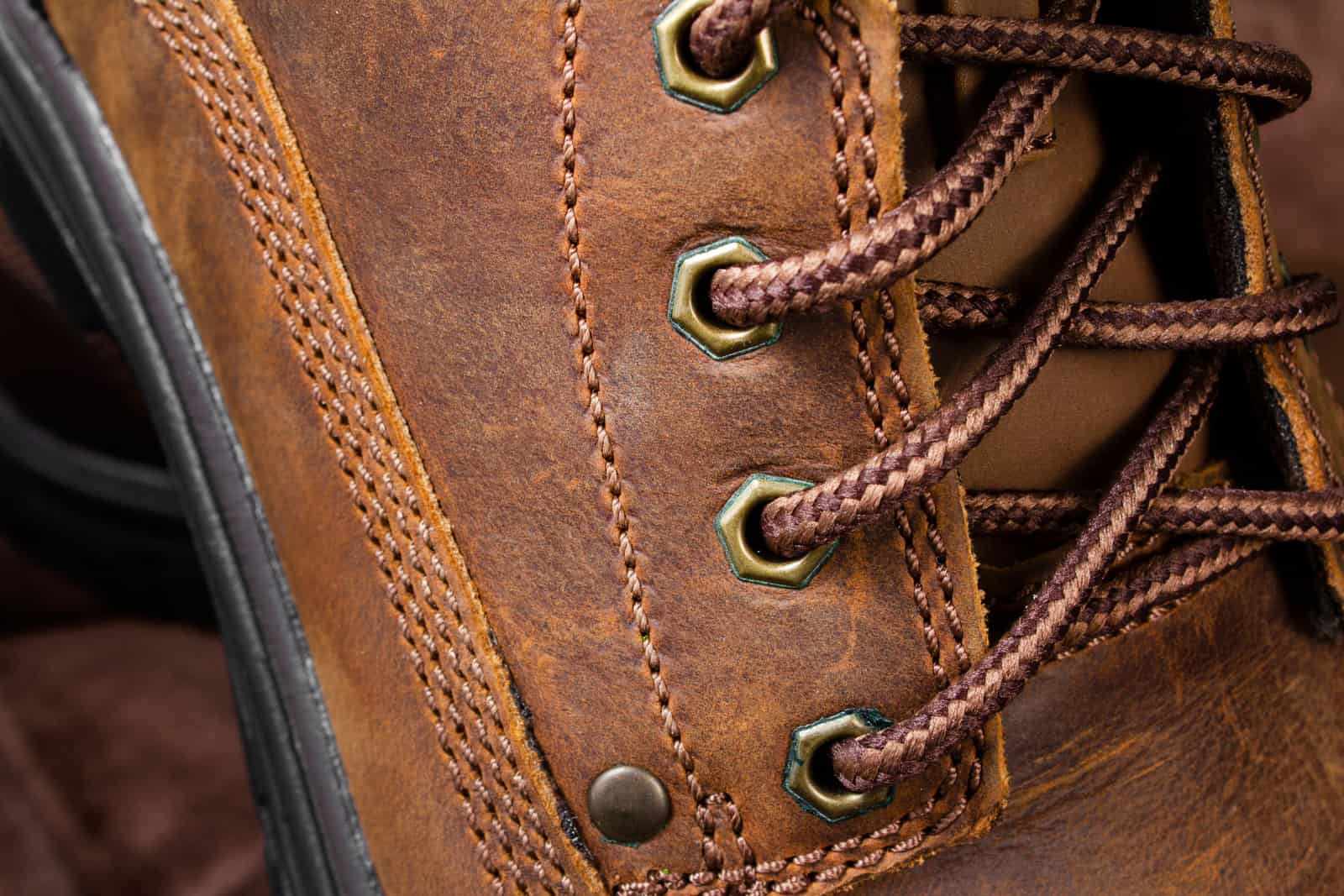
Flex the boot at the crease across the vamp - the fold that forms where your foot bends - and look at what the leather does. Healthy leather creases and relaxes. Depleted leather shows fine pale lines in the fold that stay visible after you release it, and feels papery rather than pliable under a thumb.
That is the signal, and it appears at the flex crease and the welt area first because that is where the leather works hardest. If you check one place on a boot, check there. It is the same principle as the beading test for waterproofing in how often should you reproof boots - the boot answers the question better than a number does.
Can you condition boots too often?
Yes, and it is a real failure mode rather than a theoretical one. Three things go wrong when a boot is over-conditioned.
- Structure softens. Leather that has been repeatedly loaded with oil goes slack. On a dress boot that is cosmetic; on a work boot you rely on for ankle support it is a safety-relevant change. Heavy softening pastes such as mink oil do this deliberately, which is exactly why they are the right product for a rigid old boot and the wrong one for a boot in service.
- Surplus sits on the surface and attracts grit. Conditioner that never absorbs is not doing anything except collecting dirt. Apply thinly, let it absorb, then buff off whatever is left. The only conditioner that counts is the conditioner that went in.
- It interferes with the proofing step. A boot glossy with unabsorbed conditioner does not take a wax or a spray properly. Condition, let it absorb fully, then proof.
Never condition a wet boot
The fiber spaces are full of water, so an oil-based product cannot enter - you get a greasy surface over untreated leather. It also slows the remaining moisture from leaving, which is how you end up with a boot that stays damp inside and starts to smell.
And do not accelerate the drying to get to the conditioning sooner. Atsko is explicit that force drying with heat causes leather to harden and shrink. The waiting is part of the method.
A realistic schedule, by how you actually use the boots
| Use | Baseline rhythm | Plus |
|---|---|---|
| Occasional, dry conditions | Twice a year, per Lexol’s published interval | After any soaking |
| Daily commute, salted winter | Monthly through the season | After every clean |
| Work boots, wet most days | Monthly, with a heavier dressing | Whenever the crease looks pale |
| Stored out of season | Once before storage | Once when they come back out |
The rows below the first are our own reading of the depletion events described above, not a manufacturer figure - only the twice-a-year baseline is published. We would rather label that clearly than present all four rows as though they carried the same authority.
What a conditioning session actually involves
Part of the reason people under-condition is that they imagine it as a bigger job than it is. Cleaning the boots is the work. The conditioning itself is about ten minutes of hands-on time plus waiting.
Thin coat on a cloth, worked into the leather in circles, with extra attention at the flex crease and the welt. A few hours somewhere warm to absorb. Buff off whatever is still sitting on the surface. That is the whole procedure, and doing it four times a winter is perhaps forty minutes across the season.
Set against that, the thing you are preventing is a crack across the vamp, which is permanent and which no product closes. The oils deplete with every wet-dry cycle until the fibers stop flexing, the leather stiffens, and the fold fails. It is the one failure mode in boot care with no remedy, which is why the cheap, boring, twice-a-year habit is the highest-value thing on this site.
Do new boots need conditioning?
Usually not immediately, and this is a common way to start a boot off badly. A new boot leaves the factory with a finish and a fill already in the leather, and loading more oil into it before it has been worn softens a structure that has not yet settled around your foot.
The exception is a boot that has spent a long time in a warehouse or on a shelf, which can arrive genuinely dry - the flex-crease test answers that in five seconds. Otherwise, wear them, and let the first real soaking or the first clean be the trigger. What most new boots do want before they go outside is a waterproofer rather than a conditioner, and that is a different product with a different job.
Boots that need a different answer
- Suede and nubuck. Never conditioned, at any interval. A liquid stains the nap and a cream mats it. These are maintained mechanically with a brush and a crepe eraser block - how to clean suede boots has the method.
- Boots already treated with a heavy wax dressing. A wax film is designed to stop liquids entering the leather, and it does not distinguish between rain and your conditioner. Clean the old dressing off first, condition, then re-proof.
- Boots you rely on for ankle support. Repeated heavy oiling softens the structure. Condition on the events above rather than adding extra sessions for good measure, and avoid softening pastes unless the boot is already rigid.
Clean first, every time
Conditioner applied over road grime and old dressing bonds to the grime rather than the leather. The sequence that works is clean, dry completely, condition, then proof, and the cleaning half is in how to clean leather boots.
Which conditioner to use is a smaller decision than how often. A thin liquid penetrates dried-out leather better; a cream is pleasanter for routine maintenance and is the one to pick if color matters. That comparison is in Lexol vs Bickmore Bick 4, and the wider field is ranked in the conditioner roundup.
The short version
Twice a year as a floor, because that is what the one manufacturer willing to publish a number says. Monthly through a salted winter. Always after a soaking, always after a clean, always before storage. And when in doubt, flex the boot and look at the crease - it will tell you before the calendar does.
Two makers that do publish numbers, for the boots they made. Blundstone gives a three-month reproofing interval and is explicit that its leather “does not offer full waterproof protection” on its own - how to clean Blundstone boots. Red Wing publishes no interval at all but does publish which of its conditioners belongs on which of its leathers, which is the more consequential question - Red Wing boot care.
What we would buy for this
Chosen from the same registry as our roundups, on published specifications rather than on testing we have not done.
Lexol
Lexol Leather Conditioner
A thin liquid conditioner that soaks in rather than sitting on top, with the reapplication interval published on the label.
Skip it if: You are conditioning suede. Liquid conditioners flatten and stain a napped surface.
#ad Price as of October 21, 2026, from Amazon. Prices change. How this site is funded.
Bickmore
Bickmore Bick 4 Leather Conditioner
The default conditioner for boots you want to stay the color they already are - it is sold specifically on not darkening leather.
Skip it if: You want a waterproof barrier - a conditioner feeds leather, it does not seal it.
#ad Price as of October 21, 2026, from Amazon. Prices change. How this site is funded.
Fiebing's
Fiebing's Mink Oil Paste
A heavy softening paste that will darken your boots and soften them noticeably - both of which are the point, and both of which surprise people.
Skip it if: The boots need to hold their shape or their color. Mink oil softens structure and darkens leather permanently.
#ad Price as of October 21, 2026, from Amazon. Prices change. How this site is funded.
Frequently asked
How often should you condition leather boots?
Lexol publishes every six months for ongoing care, and that is the only manufacturer interval we can source. Treat it as a floor: condition additionally after every soaking, after every clean, monthly through a salted winter, and once before the boots go into storage.
Can you condition boots too much?
Yes. Repeated heavy conditioning softens the leather structure, which matters on a boot you rely on for ankle support. Surplus that never absorbs sits on the surface collecting grit, and it stops a waterproofer taking properly. Apply thinly, let it absorb, buff off the rest.
How do you know when boots need conditioning?
Flex the boot at the crease across the vamp. Healthy leather creases and relaxes; depleted leather shows fine pale lines that stay visible after you release it and feels papery under a thumb. The flex crease and the welt show it first because that is where the leather works hardest.
Should you condition boots in winter?
More often, not less. Road salt residue is hygroscopic and keeps drawing moisture and oils through the leather, and every salt clean removes more oil. Monthly through the season is more realistic than the twice-a-year baseline.
Do you condition before or after waterproofing?
Before. Clean, dry completely, condition, then proof. The waterproofer goes last because its whole function is to stop liquids entering the leather - including the conditioner you were about to apply.
Can you condition damp boots?
No. The fiber spaces are full of water, so an oil-based conditioner cannot get in, and sealing a damp boot slows the remaining moisture from leaving. Wait until they are dry through, and do not use heat to speed that up.
Where the figures on this page came from
- Lexol - Leather Conditioner (sizes, no greasy residue or silicones, 6-month interval)
- Bickmore - leather care product range
- Moneysworth & Best - winter shoe cleaning and storing tips (salt can eat away at leather if not removed promptly)
- Atsko - Boot Care (force drying causes leather to harden and shrink)
- Blundstone - Boot Care (drying, artificial heat sources)