Rock salt vs brine vs magnesium chloride
Cities stopped relying on scattered rock salt years ago. Knowing what actually goes on your street explains why the tideline turns up in November, on a boot that never walked through slush.
By Scooter M., Enthusiast. Published September 6, 2026.
We earn a commission if you buy through the links on this page, at no extra cost to you. It never changes a ranking, and we recommend products with no affiliate link behind them where those are the right answer. Full disclosure.
The single most useful thing on this page: brine goes down before the storm, not during it. The EPA describes Rhode Island applying “a brine solution (23.3% salt-water solution) to the roads before a forecasted snow event”, a practice it calls anti-icing, which “prevents the formation of frost on pavement”.
Which means the white line on your boots in mid-November, before the first proper snowfall, is not a mystery and it is not your imagination. You walked across a street that had been salted for weather that had not arrived yet. If you have been waiting for snow before you start protecting your boots, you have been starting late for years.
What is actually on the street
The University of Minnesota Extension puts the field in one sentence: “sodium chloride is the most commonly used product for deicing roads, sidewalks, parking lots and driveways. Other deicing chemicals include magnesium chloride, calcium chloride, calcium magnesium acetate and urea.” The same page notes that de-icing salts “reduce the melting point of water from 20°F to -30°F depending on the formulation”.
That temperature range is the whole reason more than one chemical exists. Ordinary rock salt stops being useful when it gets cold enough; the other chlorides keep working further down. So the colder your city gets, the more likely it is that what you are walking through is not simply sodium chloride.
The three, and what each one does to a boot
| Form | How it is applied | How your boots meet it | What you see |
|---|---|---|---|
| Rock salt (sodium chloride) | Scattered as solid crystals, during or after the event | Dissolved in slush, soaked into the leather with the water | The classic hard white tideline at slush height |
| Brine (23.3% salt solution) | Sprayed on the road before a forecast storm | Picked up as liquid, often on a dry day | A fainter, more even bloom, and earlier in the season |
| Magnesium or calcium chloride | Used where it gets too cold for rock salt alone | Same as brine - already in solution when you meet it | A residue that can stay tacky rather than drying crisp |
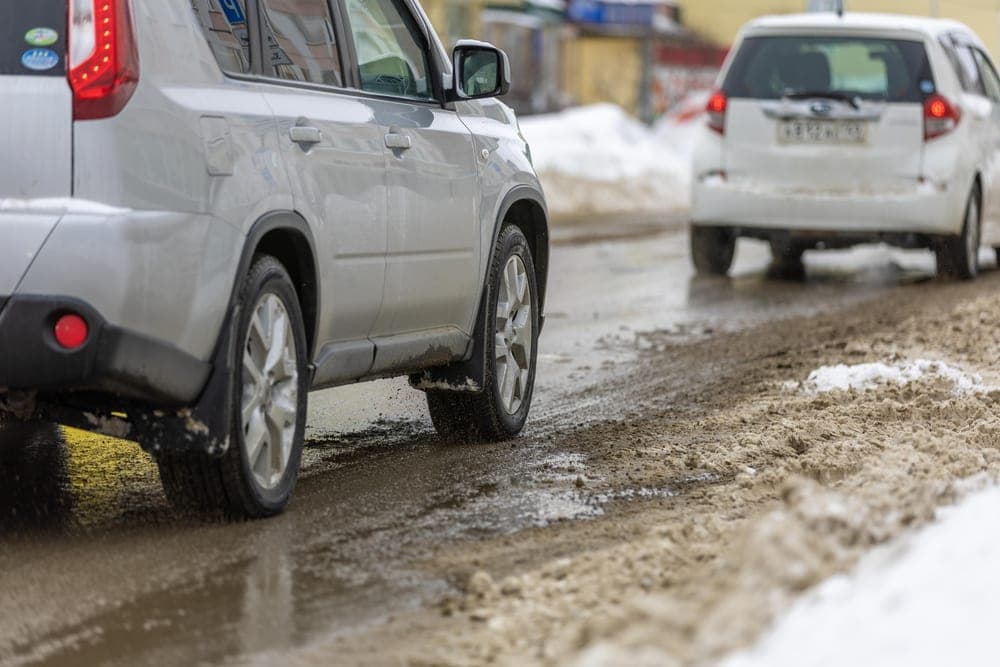
Rock salt: the one everybody pictures
Solid crystals, spread onto snow and ice. The mechanism is freezing-point depression - the EPA describes salt additives as lowering “the freezing point of water, slowing down the formation of ice” - and it needs moisture to do anything at all.
For your boots, this is the well-understood case. The salt dissolves in slush, the slush soaks into the leather, the water evaporates and the salt does not. What is left is a crystalline deposit sitting in the fibers, and it stays hygroscopic, so it keeps drawing moisture through the leather and keeps taking the oils with it. Moneysworth & Best state plainly that salt can eat away at leather if it is not removed promptly. The tideline you can see is the marker; the oil loss is the damage.
Brine: the one that changes your calendar
A 23.3 percent salt-and-water solution, sprayed onto dry pavement ahead of a forecast event so that ice cannot bond to the road in the first place. It is efficient, it uses less salt overall, and from a boot-care point of view it has one consequence that nobody tells you.
You can pick it up on a clear, cold, entirely snow-free day. There is no slush to warn you and no obvious moment where you think “I should clean these tonight”. The residue goes on evenly rather than as a splash line, so it often shows up as a general dullness or a faint bloom rather than the sharp tideline people are watching for - and it gets ignored for weeks.
The practical response is a date change, not a product change. Start the winter routine when the forecast first mentions freezing, not when the first snow lands. That routine is in how to prevent salt stains, and it takes about fifteen seconds a day.
The colder-weather chlorides
Magnesium chloride and calcium chloride appear where sodium chloride runs out of temperature range. The EPA notes that magnesium chloride “is considered to be safer than NaCl” and that calcium chloride “is safer for the environment but is three times more expensive”, which is why neither has displaced rock salt outright.
On boots, the thing owners notice is that the residue from these blends often does not dry to a crisp crust the way rock salt does. It can stay slightly tacky and pick up road grit, which turns a chemical problem into a mechanical one - you are now dealing with a film that holds dirt against the leather.
We want to be straight about the limits of what we can tell you here. Municipal mixes are not published in a form a boot owner can look up, no boot manufacturer publishes a different removal method by chloride type, and we have not found a consumer-grade published figure for how each behaves on leather specifically. So this section is about what changes in your habits, not a claim that you need a different bottle for each.
Three de-icers, one removal method
All of these are soluble chloride salts. That means the fix does not change: brush off what is loose, dissolve the rest with a dilute solution, wipe the residue off with clean water, dry away from heat, then condition. Timberland publishes a one-part-vinegar-to-two-parts-water solution for stains on leather and suede, and it is the correct first attempt whichever chemical produced the line.
The full procedure is in removing salt stains from leather boots. What changes with brine is only when you start doing it.
Sidewalks are usually worse than roads
Road treatment is done by agencies working to an application rate. Sidewalks, entrances and parking lots are done by property owners with a bucket, and the usual instinct is to over-apply. The University of Minnesota Extension’s guidance for the job is about 12 ounces per 1,000 square feet, which is far less than most people scatter.
For your boots that means the heaviest exposure of the day is often the twenty feet between the sidewalk and an office door, not the walk itself. It is also why the crust on a boot is frequently worse in a mild week than a snowy one - undissolved excess sitting dry on concrete transfers straight onto the welt.
How much of this is out there
Worth a sense of scale, because it explains why this is a seasonal certainty rather than bad luck. The EPA notes that nearly half a million tons is used annually in Massachusetts alone, and that road salt “can also infiltrate nearby surface and ground waters and can contaminate drinking water reservoirs and wells”.
For a boot owner the relevant consequence is simpler than the environmental one: in a salted region there is effectively no such thing as a clean winter street between December and March. You are not going to avoid contact by choosing your route, and a boot that only gets attention after an obvious slush event is getting attention perhaps a quarter as often as it needs it.
That is the case for a fifteen-second daily wipe rather than an occasional deep clean. It is also the case for treating the boots before the season rather than during it, since the treatment is what stops the residue reaching the fibers in the first place.
Why the conditioning step matters more than the wipe
Whatever put the line there, the residue is hygroscopic and it has been pulling moisture and oil through the leather for as long as it has been sitting in the fibers. So the boot is drier after a salted week than before it, and drier again after you clean it - because vinegar, saddle soap and every dedicated remover take oils out along with the salt.
Clean, dry fully, condition. The third step is the one people skip and it is the one that decides whether the season ends with supple boots or a crack across the vamp. Method and timing are in conditioning boots after they get wet.
Drying is the other half. Atsko is explicit that force drying with heat causes leather to harden and shrink, and Blundstone tells you never to dry boots by an artificial heat source. A radiator after a salty walk does more damage than the salt.
The prevention side, given what you now know
If two of the three de-icers go down before the snow does, prevention has to start earlier than instinct suggests. Two things are worth doing in the week the forecast first mentions a freeze.
- Proof the boots before the first treatment run, not after the first storm. A treated boot sheds a brine film far better than an untreated one. Which product suits which leather is in winter boot waterproofing.
- Wipe them down on days it did not snow. This is the habit that brine specifically requires and that almost nobody has. A damp cloth across the lower third of the boot when you get in costs nothing and removes the residue while it is still on the surface rather than in the fibers.
What we would actually do
Assume brine. It is the case that catches people out, it is increasingly the default in cities, and treating for it is strictly more cautious than treating for rock salt. Proof the boots in early autumn, wipe them down through the winter regardless of whether it snowed, use a dilute vinegar solution on any line that appears, and condition afterwards every time. The product shortlist for the removal step is in the salt stain remover roundup, where the top pick is a pantry item.
What we would buy for this
Chosen from the same registry as our roundups, on published specifications rather than on testing we have not done.
Iberia
Iberia Distilled White Vinegar, 1 gallon
The cheapest thing on this site and the first thing to try - Timberland's own stain guidance is one part vinegar to two parts water.
Skip it if: The leather is already dry and cracked. Acid on damaged leather makes the damage worse; condition first.
#ad Price as of October 21, 2026, from Amazon. Prices change. How this site is funded.
Moneysworth & Best
Moneysworth & Best Salt Stain Remover
One of the few products in North America sold specifically for road-salt tidelines, from a maker that publishes a winter care procedure to go with it.
Skip it if: The stain is fresh and light. A 1:2 vinegar-and-water wipe costs nothing and usually works.
#ad Price as of October 21, 2026, from Amazon. Prices change. How this site is funded.
Fiebing's
Fiebing's Saddle Soap
A century-old glycerine soap that lifts salt and grime together, from a maker that still publishes a product page for it.
Skip it if: The boots are suede or nubuck - soap mats the nap.
#ad Price as of October 21, 2026, from Amazon. Prices change. How this site is funded.
Bickmore
Bickmore Bick 4 Leather Conditioner
The default conditioner for boots you want to stay the color they already are - it is sold specifically on not darkening leather.
Skip it if: You want a waterproof barrier - a conditioner feeds leather, it does not seal it.
#ad Price as of October 21, 2026, from Amazon. Prices change. How this site is funded.
Frequently asked
Why do my boots have salt stains before it has snowed?
Because brine goes down first. The EPA describes road agencies applying a 23.3 percent salt solution to pavement before a forecast storm, a practice called anti-icing. You can pick that residue up on a completely dry day, which is why tidelines appear earlier in the season than people expect.
Is brine worse for boots than rock salt?
Not chemically - both are chloride salt in solution by the time they reach your leather. It is worse in practice because it arrives without slush to warn you and spreads evenly rather than as an obvious tideline, so it tends to sit on the boot for weeks before anyone notices it.
Does magnesium chloride damage leather differently?
We have not found a published, consumer-grade figure comparing the chlorides on leather specifically, so we will not claim one. What owners notice in practice is that magnesium and calcium chloride residues often stay slightly tacky rather than drying to a crust, which makes them better at holding road grit against the boot.
Do you remove different de-icers in different ways?
No. They are all soluble chloride salts, so the method is the same: brush off what is loose, dissolve the rest with a dilute solution - Timberland publishes one part vinegar to two parts water - wipe the residue off with clean water, dry away from heat, then condition.
When should I start protecting boots from road salt?
When the forecast first mentions a freeze, not when the first snow falls. Anti-icing brine is applied ahead of forecast events, so the treatment on the road can precede the weather by a day or more.
Where the figures on this page came from
- US EPA - Winter is Coming! And with it, tons of salt on our roads (freezing-point depression, 23.3% brine anti-icing, magnesium and calcium chloride)
- University of Minnesota Extension - The effects of deicing salts on landscapes (which chemicals are used, melting point range)
- Moneysworth & Best - winter shoe cleaning and storing tips (salt stain remover, product codes, salt warning)
- Timberland - How to remove stains from leather or suede boots (1:2 vinegar solution, method, drying)
- Atsko - Boot Care (force drying causes leather to harden and shrink)
- Blundstone - Boot Care (salt, drying, artificial heat sources)