Skip to content
Boot & Brush
Roundup

The best boot dryers for work boots

Work boots break dryers in a specific way: they are taller than the tubes, wetter than the rating, and they go back on at six the next morning. Here is what to buy for that.

By Scooter M., Enthusiast. Published September 1, 2026.

We earn a commission if you buy through the links on this page, at no extra cost to you. It never changes a ranking, and we recommend products with no affiliate link behind them where those are the right answer. Full disclosure.

Quick picks

The shortlist, ranked

Ranked on published manufacturer specifications and, where a wattage figure exists, computed running cost. Tap any row for the full write-up, including who should skip it.

#ProductBest forScorePrice
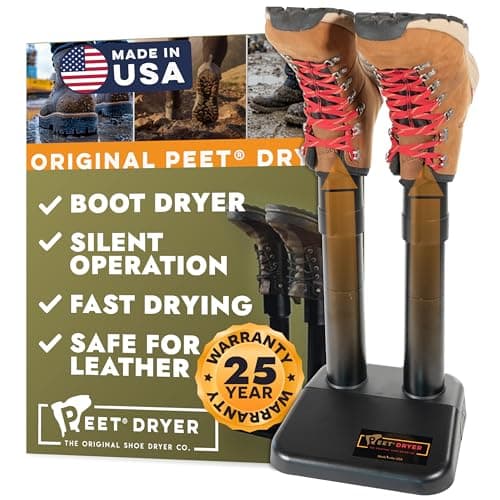
01An electric footwear dryer of the type described - a stand-in for the PEET Original XL Tall Shoe & Boot Dryer, not a photograph of this modelPEET Original XL Tall Shoe & Boot DryerTaller work boots on the same 36-watt budgetBest overall for work boots8.9Check price on Amazon
02An electric footwear dryer of the type described - a stand-in for the PEET Advantage Plus 4-Shoe Dryer, not a photograph of this modelPEET Advantage Plus 4-Shoe DryerSame-evening turnaround before a 6 am startBest for a 6 am start8.8Check price on Amazon
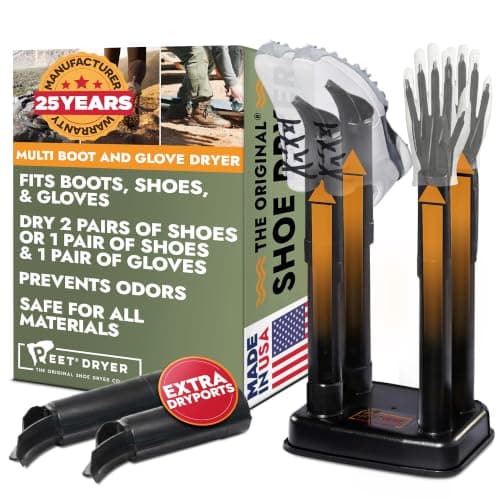
03An electric footwear dryer of the type described - a stand-in for the PEET Multi Shoe & Glove Dryer, not a photograph of this modelPEET Multi Shoe & Glove DryerA household drying two pairs at onceBest for two workers8.6Check price on Amazon
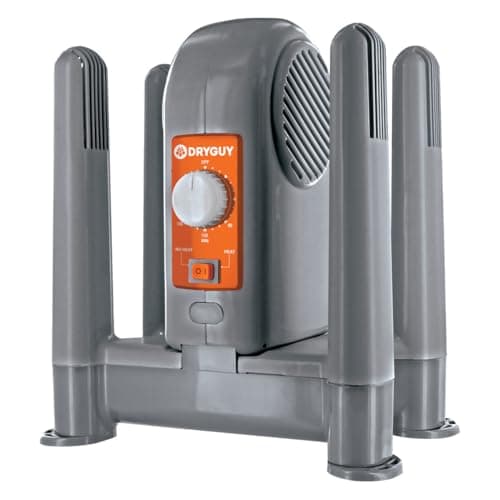
04An electric footwear dryer of the type described - a stand-in for the DryGuy Force Dry DX, not a photograph of this modelDryGuy Force Dry DXSki and snowboard boots that must be dry by morningFastest turnaround8.0Check price on Amazon
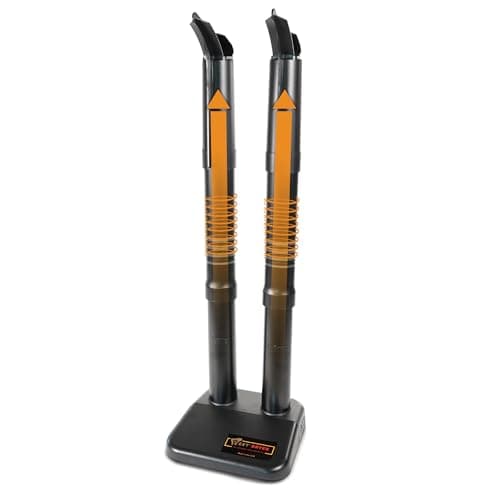
05An electric footwear dryer of the type described - a stand-in for the PEET Original 2-Shoe Dryer, not a photograph of this modelPEET Original 2-Shoe DryerOne pair, every night, all winterBest value9.1Check price on Amazon

Scores are ours and editorial. They are never published as review or rating markup, because we have not tested these products.

For daily work boots, buy on tube height first and speed second. A dryer that does not reach the toe of an 8-inch boot is drying the ankle and leaving the wettest part alone, and a work boot that goes back on damp every morning is the exact condition that produces the smell, the rot and the cracked flex point.

Why work boots are a different problem

  • They are taller. A 6- or 8-inch work boot needs real tube length. PEET publishes overall heights: 22 inches for the Original, 24.5 for the XL Tall. That 2.5 inches is the difference between air reaching the toe box and air stopping at the ankle.
  • They are wetter. Not just weather - sweat. A full shift in insulated, membrane-lined safety boots puts a lot of moisture into the lining even on a dry day.
  • They go back on every day. There is no rest day for the leather to catch up, which is why the Cleveland Clinic’s advice to rotate footwear is so relevant here and so impractical for most people who own one pair of safety boots.
  • They are usually leather. Which means the heat setting on a forced-air dryer is a tool to use occasionally, not a default. Atsko is explicit that repeated force drying with heat hardens and shrinks leather.

What it costs to run one every night of the year

Work boots get dried far more often than hiking boots, so the running cost is worth doing properly. At 36 watts and the EIA average residential rate of 18.34 cents per kWh, an overnight run costs $0.053. Run every working night of a year - about 250 - that is $13.25 a year. The 220-watt forced-air unit on a two-hour cycle, 250 times, is $20.17.

Neither number is a reason to choose one over the other, and that is the useful finding: for a work boot, buy for height, speed and durability, and treat electricity as noise. Run the numbers on your own rate.

Two pairs of insoles beats one expensive dryer

The footbed is the wettest part of a work boot and it dries in a fraction of the time outside the boot. A second pair of insoles rotated daily means the part touching your foot is always dry, which is the single biggest improvement available for the money.

The warranty question

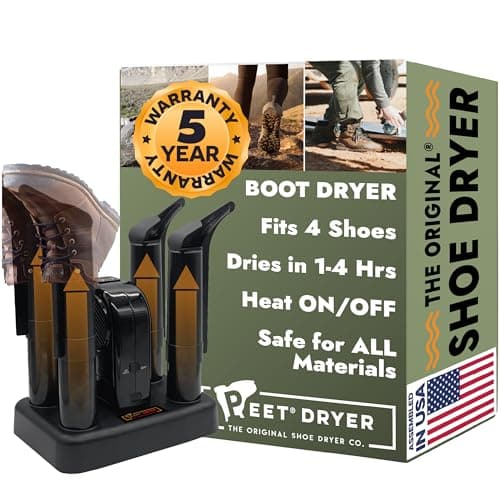
A dryer used 250 nights a year is a different purchase from one used twenty times a winter. PEET publishes a 25-year warranty on its convection models and 5 years on the Advantage Plus; DryGuy publishes 1 year across the range we looked at. Convection dryers also have no moving parts to fail, which matters more at 250 cycles a year than at twenty.

If your boots also smell - and daily work boots usually do - the drying is the fix, not the spray.

The write-ups

Every pick, in full

01 / Best overall for work bootsAn electric footwear dryer of the type described - a stand-in for the PEET Original XL Tall Shoe & Boot Dryer, not a photograph of this model

PEET

8.9 / 10

PEET Original XL Tall Shoe & Boot Dryer

The Original with another 2.5 inches of tube, which is the difference between drying a work boot and drying only its ankle.

Check price on Amazon

#ad We hold no verified live price for this product, so we show none. How this site is funded.

Published specifications for the PEET Original XL Tall Shoe & Boot Dryer
SpecificationValueSource
Power36 WPEET Dryer published specifications
Current draw0.3 A at 120 VPEET Dryer published specifications
Height24.5 inPEET Dryer published specifications
Weight3 lbPEET Dryer published specifications
Warranty25 yearsPEET Dryer published specifications

What it costs to run

About 5 cents per 8-hour night, or $4.75 across a 90-night wet season.

0.036 kW x 8 h = 0.288 kWh x $0.1834 = $0.053 a night; x 90 = $4.75.

What it does well

  • Identical 36 W and 25-year warranty to the Original
  • 2.5 in of extra reach for very little money
  • Completely silent

What it does not

  • Still one pair
  • Still an overnight dryer
  • Taller to store

Skip this one if

Your boots are knee-height or waders - at 24.5 in overall this still will not reach the top.

How it scores, by criterion

Running cost9.6
Capacity6.0
Boot-height reach8.0
Speed6.0
Warranty10.0
Published documentation9.5
02 / Best for a 6 am startAn electric footwear dryer of the type described - a stand-in for the PEET Advantage Plus 4-Shoe Dryer, not a photograph of this model

PEET

8.8 / 10

PEET Advantage Plus 4-Shoe Dryer

The fast one: 220 watts of forced heated air that PEET publishes as a 1-to-4-hour job, with a no-heat mode that drops to a third of an amp.

Check price on Amazon

#ad We hold no verified live price for this product, so we show none. How this site is funded.

Published specifications for the PEET Advantage Plus 4-Shoe Dryer
SpecificationValueSource
Power (heat)220 WPEET Dryer published specifications
Current draw1.833 A heat / 0.33 A no heat, at 120 VPEET Dryer published specifications
Drying time1 to 4 hoursPEET Dryer published specifications
Dimensions8.5 x 13.5 x 18.5 inPEET Dryer published specifications
Weight5.25 lbPEET Dryer published specifications
Warranty5 yearsPEET Dryer published specifications

What it costs to run

About 8 cents for a 2-hour heated cycle, or 32 cents left on all night.

220 W = 0.22 kW. Two-hour cycle: 0.22 x 2 = 0.44 kWh x $0.1834 = $0.081. Eight hours: 1.76 kWh x $0.1834 = $0.323. Ninety 2-hour cycles: 39.6 kWh x $0.1834 = $7.26.

What it does well

  • Published 1-4 hour drying time against 4-8 for convection
  • A documented no-heat mode at 0.33 A - use it on leather
  • Four ports

What it does not

  • 220 W with heat on, six times the Original
  • 5-year warranty, not 25
  • It has a fan, so it makes noise

Skip this one if

Your boots are leather and you planned to run the heat setting nightly. Atsko is explicit that force drying with heat hardens and shrinks leather.

How it scores, by criterion

Running cost6.5
Capacity9.0
Boot-height reach7.5
Speed9.5
Warranty7.5
Published documentation9.5
03 / Best for two workersAn electric footwear dryer of the type described - a stand-in for the PEET Multi Shoe & Glove Dryer, not a photograph of this model

PEET

8.6 / 10

PEET Multi Shoe & Glove Dryer

Four ports on 72 watts - two pairs of boots, or a pair plus gloves, for about eleven cents a night.

Check price on Amazon

#ad We hold no verified live price for this product, so we show none. How this site is funded.

Published specifications for the PEET Multi Shoe & Glove Dryer
SpecificationValueSource
Power72 WPEET Dryer published specifications
Current draw0.6 A at 120 VPEET Dryer published specifications
Height25 inPEET Dryer published specifications
Weight5 lbPEET Dryer published specifications
Warranty25 yearsPEET Dryer published specifications

What it costs to run

About 11 cents per 8-hour night, or $9.51 across a 90-night season - for two pairs.

72 W = 0.072 kW. 0.072 x 8 h = 0.576 kWh x $0.1834 = $0.106 a night; x 90 = $9.51. Per pair that is $4.75, identical to running one Original.

What it does well

  • Four ports - two pairs, or boots plus gloves
  • Still silent, still no moving parts
  • 25-year warranty

What it does not

  • Double the wattage for double the ports - no efficiency gain per pair
  • 13.25 in wide, so it needs real shelf space
  • Overnight only

Skip this one if

You need one pair dry fast. Four ports on a convection element is still an overnight job.

How it scores, by criterion

Running cost8.6
Capacity9.0
Boot-height reach8.0
Speed6.0
Warranty10.0
Published documentation9.5
04 / Fastest turnaroundAn electric footwear dryer of the type described - a stand-in for the DryGuy Force Dry DX, not a photograph of this model

DryGuy

8.0 / 10

DryGuy Force Dry DX

Forced air capped at 105 F with a 3-hour timer - the fast choice, except DryGuy publishes no wattage, so nobody can cost it honestly.

Check price on Amazon

#ad We hold no verified live price for this product, so we show none. How this site is funded.

Published specifications for the DryGuy Force Dry DX
SpecificationValueSource
Max temperature105 F / 40.5 CDryGuy published specifications
Timer3 hoursDryGuy published specifications
Drying timeMost garments in 1-2 hoursDryGuy published specifications
Dimensions15.08 x 7.6 x 12.44 inDryGuy published specifications
Warranty1 yearDryGuy published specifications
PowerNot published by the manufacturerDryGuy published specifications

What it does well

  • Published 1-2 hour drying time
  • Temperature capped at 105 F, gentler than an unregulated heat source
  • Four garments at once, with extension tubes for taller boots

What it does not

  • No published wattage, so its running cost cannot be computed from the maker's own data
  • 1-year warranty against PEET's 25
  • Fan noise

Skip this one if

You want to know what it costs to run. The maker publishes temperature, timer and dimensions but not watts or amps, and we will not print a number we cannot source.

How it scores, by criterion

Running cost5.0
Capacity9.0
Boot-height reach8.0
Speed9.5
Warranty4.0
Published documentation5.0
05 / Best valueAn electric footwear dryer of the type described - a stand-in for the PEET Original 2-Shoe Dryer, not a photograph of this model

PEET

9.1 / 10

PEET Original 2-Shoe Dryer

The convection dryer the rest of the category gets measured against: 36 watts, no fan, no noise, and a 25-year warranty behind it.

Check price on Amazon

#ad We hold no verified live price for this product, so we show none. How this site is funded.

Published specifications for the PEET Original 2-Shoe Dryer
SpecificationValueSource
Power36 WPEET Dryer published specifications
Current draw0.3 A at 120 VPEET Dryer published specifications
Height22 inPEET Dryer published specifications
Weight2.5 lbPEET Dryer published specifications
Warranty25 years (register within 10 days)PEET Dryer published specifications
Drying time4-8 hours, or overnightPEET Dryer FAQ

What it costs to run

About 5 cents per 8-hour night, or $4.75 across a 90-night wet season.

36 W = 0.036 kW. 0.036 x 8 h = 0.288 kWh per night. 0.288 x $0.1834 = $0.053. Ninety nights: 25.92 kWh x $0.1834 = $4.75.

What it does well

  • 36 W is the lowest running cost of any full-size dryer we can source a published figure for
  • Silent - there is no fan, so it can live in a bedroom
  • 25-year warranty, the longest published in the category

What it does not

  • One pair at a time
  • Overnight, not same-evening
  • 22 in of height reaches a work boot, not a knee boot

Skip this one if

You need boots dry in two hours. PEET's own FAQ puts non-fan models at 4 to 8 hours.

How it scores, by criterion

Running cost9.6
Capacity6.0
Boot-height reach7.0
Speed6.0
Warranty10.0
Published documentation9.5

How these picks were chosen

Everyone in this category says they tested twenty dryers. We have not tested any, and we say so. What we did instead: read the manuals, compile the published specifications, compute the running cost from the manufacturer's own wattage figure, and show the arithmetic so you can check it.

The full method, including what we refuse to claim.
Questions

Frequently asked

What size boot dryer do I need for 8-inch work boots?

Check the published overall height. PEET lists 22 inches for the Original and 24.5 for the XL Tall; the taller model is the safer choice for an 8-inch boot because the air needs to reach the toe box, not just the ankle.

Can I use a boot dryer on steel-toe boots?

Yes. The steel or composite cap is not affected by the warm air, and it is usually the last part of the boot to warm up, which is a useful indicator of whether the toe box is dry.

How much does running a boot dryer every night cost per year?

At 36 published watts and 18.34 cents per kWh, an 8-hour run is $0.053. Over 250 working nights that is $13.25 a year. A 220 W forced-air unit on 2-hour cycles over the same 250 nights is $20.17.

Should I use the heat setting on work boots?

Sparingly. Atsko states that force drying with heat causes leather to harden and shrink over a few cycles. Use the no-heat mode as your default - the PEET Advantage Plus publishes one at 0.33 amps - and save heat for the nights you genuinely need the boots by morning.

Sources

Where the figures on this page came from

  1. US Energy Information Administration, Electric Power Monthly, Table 5.3 - average residential price of electricity
  2. PEET Dryer - Original XL Tall specifications
  3. PEET Dryer - Advantage Plus specifications
  4. Atsko - Boot Care (force drying, beeswax melt point, drying times)
  5. Cleveland Clinic - why feet smell
Read next