The best boot dryers, ranked on published specs and running cost
Six dryers, every wattage figure taken from the manufacturer's own spec sheet, and the cost-per-season arithmetic shown. Nobody else in this category publishes it, which is why we did.
By Scooter M., Enthusiast. Published September 1, 2026.
We earn a commission if you buy through the links on this page, at no extra cost to you. It never changes a ranking, and we recommend products with no affiliate link behind them where those are the right answer. Full disclosure.
Quick picks
The shortlist, ranked
Ranked on published manufacturer specifications and, where a wattage figure exists, computed running cost. Tap any row for the full write-up, including who should skip it.
#
Product
Best for
Score
Price
01
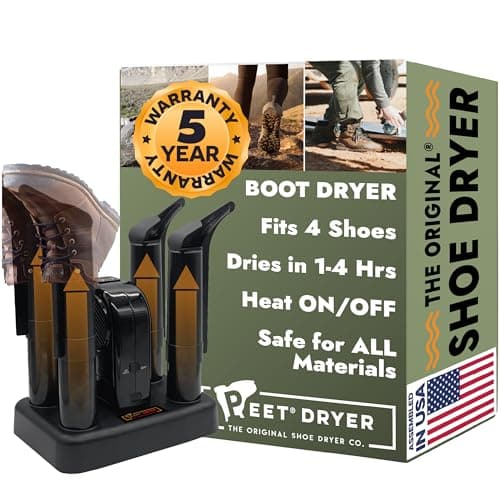
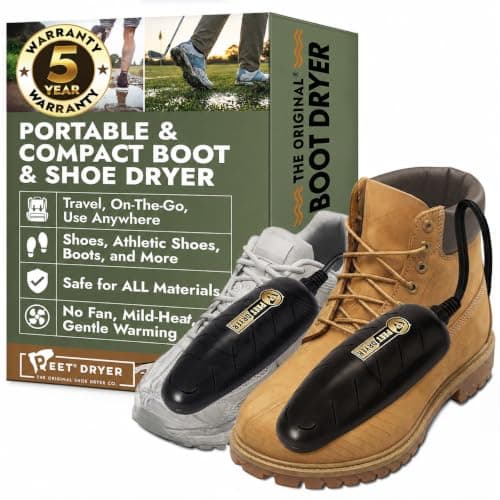
PEET Original 2-Shoe DryerOne pair, every night, all winter
Scores are ours and editorial. They are never published as review or rating markup, because we have not tested these products.
If you want one dryer and you are not in a hurry, buy a 36-watt convection stand. It is silent, it costs about five cents a night to run, and PEET puts a 25-year warranty on theirs. If you need boots dry before a 6 am start, buy a forced-air dryer instead and use its no-heat setting on leather. That is the whole decision, and everything below is the evidence for it.
What we did instead of testing
We have not tested these dryers. We do not own them, there is no lab, and saying otherwise would be the easiest thing on this page for a competitor to disprove. What we did do is read every manufacturer specification page, record the published wattage and amp draw, and compute what each unit costs to run using the EIA’s published US average residential electricity rate of 18.34 cents per kilowatt-hour.
That turned out to be the most useful thing we could have done, because not one of the eleven competing boot-dryer pages we read publishes a running-cost figure. Several imply that convection dryers are the cheap option and forced-air dryers are expensive to run. The arithmetic says something more interesting.
The problem this category exists to solve: boots that come off wet and go back on wet.
The running cost, in full
The formula is watts ÷ 1000 × hours × $/kWh. Every figure below uses the manufacturer’s own published wattage.
Model
Published watts
Per 8-hour night
90-night season
PEET Power Cell
12 W
$0.018
$1.58
PEET Original / XL Tall / Wader
36 W
$0.053
$4.75
PEET Multi (two pairs)
72 W
$0.106
$9.51
PEET Advantage Plus, 2-hour heated cycle
220 W
$0.081
$7.26
DryGuy Force Dry DX
Not published
Cannot be computed
Cannot be computed
Two things fall out of that table. The first is that a whole wet season on the cheapest convection dryer costs less than a sandwich. The second is the one that surprised us: a forced-air dryer run for the two hours it actually needs costs less per night than a convection dryer left on for eight. The 220-watt unit is only expensive if you leave it running all night, which its published 1-to-4-hour drying time says you do not need to.
So running cost is not the reason to choose between the two types. Noise, capacity and what the heat does to leather are. The full per-model calculator, with your own electricity rate lets you redo all of this with your actual number, which in the Northeast is well above the national average.
The three specs that actually decide this
1. Height, and whether the tubes reach
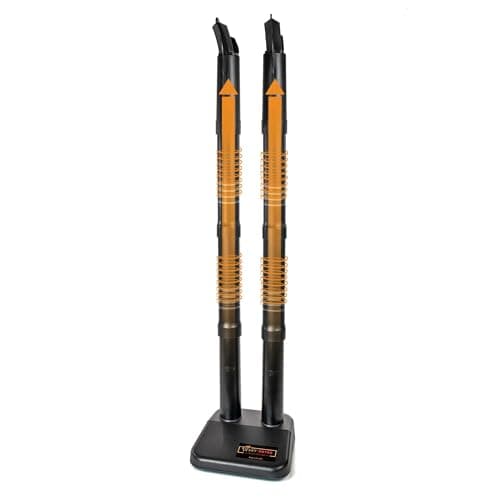
A dryer that reaches 22 inches dries a work boot. It dries the ankle of a knee boot and leaves the foot damp, which is worse than useless because it feels dry when you pick it up. PEET publishes the overall height of every model: 22 inches for the Original, 24.5 for the XL Tall, 42.5 for the Wader. Measure the inside of your tallest boot before you buy anything.
2. Heat, and whether you can turn it off
This is the specification that protects your boots. Atsko’s care guidance is blunt: “Force drying - especially with heat - will cause leather to harden and shrink. In a few cycles, the boots are trashed.” Blundstone tells you never to dry boots by an artificial heat source at all.
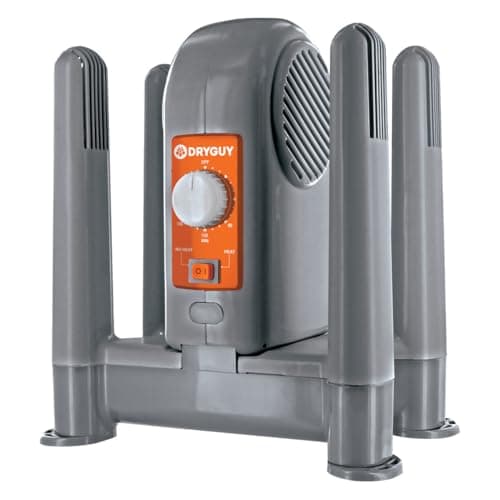
A boot dryer is not a radiator - the DryGuy units cap at a published 105 °F, which is gentle - but a heated forced-air setting used every night on leather is closer to the thing both manufacturers are warning about than a convection stand is. The PEET Advantage Plus publishes a no-heat mode at 0.33 amps. If you buy a forced-air dryer for leather boots, that setting is the one to live on, and heat is for the nights you genuinely need them by morning.
3. Whether the maker publishes anything at all
We scored every dryer here partly on documentation, and it is not padding. PEET publishes watts, volts, amps, dimensions, weight and warranty on every product page. DryGuy publishes temperature, timer and dimensions but no wattage on any of the three models we looked at. That is a real difference to a buyer: you can work out in advance what a PEET costs to run for a decade, and you cannot do that for a DryGuy without a plug-in meter you do not own yet.
The free thing to do first
Pull the insoles and the laces out before the boots go anywhere near a dryer. Both hold more water than the boot shell does, and neither dries while it is still inside. On most work boots the footbed is the wettest component in the whole assembly.
Who each of these is for
The full write-ups are below, each with its published specification table, the source for every figure, and a “skip this if” line - because the most useful thing a roundup can tell you is which pick is wrong for you.
If you are still deciding between the two technologies rather than between models, the head-to-head is here. If your actual problem is that the boots smell rather than that they are wet, a dryer may still be the right purchase - but for a different reason.
One case this ranking does not cover: a dryer you take with you. Weight, packed size and what a low-wattage unit can honestly manage away from home are a different set of trade-offs, and they are ranked separately in the portable boot dryer roundup. If you have already settled on PEET and only need to pick a model, which PEET dryer should you buy puts all six side by side on published specifications.
One material this ranking treats as ordinary is not: rubber. Muck, Xtratuf and Hunter all publish that rubber boots must dry away from artificial heat, because heat causes the crazing that ends a waterproof shell - which rules out part of the shortlist above. The rubber and muck boot dryer roundup ranks the options that stay inside that instruction.
Two follow-ups to this ranking. The rank-one pick gets a full write-up of its own, including the three jobs it cannot do, in our PEET Original review. And if the constraint is money rather than specification, the budget boot dryer roundup ranks the value tier on purchase price and running cost together.
The write-ups
Every pick, in full
01 / Best overall
PEET
9.1 / 10
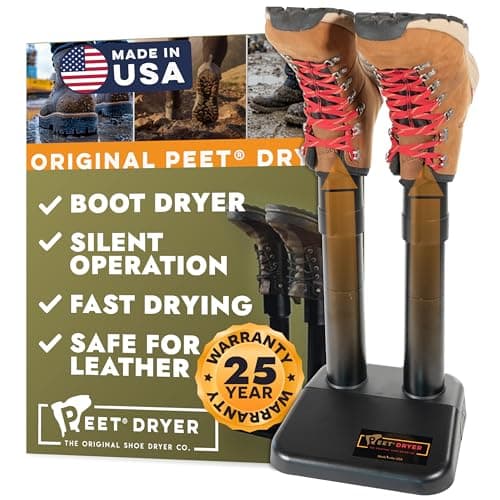
PEET Original 2-Shoe Dryer
The convection dryer the rest of the category gets measured against: 36 watts, no fan, no noise, and a 25-year warranty behind it.
+Temperature capped at 105 F, gentler than an unregulated heat source
+Four garments at once, with extension tubes for taller boots
What it does not
−No published wattage, so its running cost cannot be computed from the maker's own data
−1-year warranty against PEET's 25
−Fan noise
Skip this one if
You want to know what it costs to run. The maker publishes temperature, timer and dimensions but not watts or amps, and we will not print a number we cannot source.
How it scores, by criterion
Running cost5.0
Capacity9.0
Boot-height reach8.0
Speed9.5
Warranty4.0
Published documentation5.0
04 / Best for two pairs
PEET
8.6 / 10
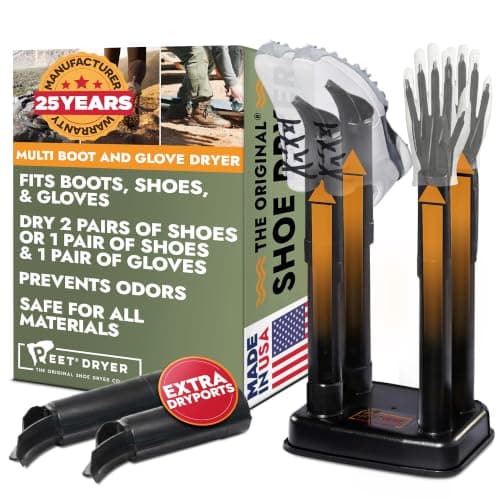
PEET Multi Shoe & Glove Dryer
Four ports on 72 watts - two pairs of boots, or a pair plus gloves, for about eleven cents a night.
Under 2 cents per 8-hour night, or $1.58 across a 90-night season.
0.012 kW x 8 h = 0.096 kWh x $0.1834 = $0.018 a night; x 90 = $1.58.
What it does well
+12 W - under two cents a night
+Packs inside a boot
+Silent
What it does not
−Damp boots only, never soaked ones
−Frequently out of stock
−5-year warranty rather than PEET's usual 25
Skip this one if
You are drying soaked boots at home. Twelve watts moves very little moisture; this is for damp, not saturated.
How it scores, by criterion
Running cost10.0
Capacity4.0
Boot-height reach5.0
Speed4.5
Warranty7.5
Published documentation9.5
How these picks were chosen
Everyone in this category says they tested twenty dryers. We have not tested any, and we say so. What we did instead: read the manuals, compile the published specifications, compute the running cost from the manufacturer's own wattage figure, and show the arithmetic so you can check it.
A 36-watt convection dryer costs about 5 cents per 8-hour night, which is $4.75 across a 90-night wet season at the EIA average US residential rate of 18.34 cents per kWh. A 220-watt forced-air dryer run for a 2-hour cycle costs about 8 cents a night, or $7.26 over the same season.
Will a boot dryer damage leather boots?
A convection dryer at 36 watts will not. A heated forced-air setting used every night is closer to what manufacturers warn against: Atsko states that force drying with heat causes leather to harden and shrink, and Blundstone says never to dry boots by an artificial heat source. Use the no-heat mode on leather and save the heat for the nights you need them by morning.
How long does a boot dryer take?
PEET's own FAQ puts non-fan models at 4 to 8 hours, or overnight. Fan-assisted dryers publish 1 to 4 hours - DryGuy states 1 to 2 hours for most garments and PEET states 1 to 4 for the Advantage Plus.
Is a boot dryer better than newspaper?
For repeat use, yes, and mainly because newspaper has to be changed. Paper works by contact absorption, so it stops working the moment it is saturated - usually within an hour or two. A dryer keeps moving air through the boot all night without you doing anything.
Do boot dryers stop boots smelling?
Indirectly, and it is the most effective thing you can buy for the problem. Foot odor is bacteria consuming sweat in a warm, damp, dark boot. A dryer removes the moisture, which is the one variable in that list you can control between wears.
Can I leave a boot dryer on overnight?
Convection models are designed for it - PEET recommends leaving footwear on the dryer overnight. Fan-assisted models generally have a timer instead: the DryGuy Force Dry DX publishes a 3-hour timer and the Force Dry a 3-hour auto shut-off.