One machine, four things to dry, and two of them are done long before the other two. Here is how the multi-port units actually compare on published figures.
By Scooter M., Enthusiast. Published September 6, 2026.
We earn a commission if you buy through the links on this page, at no extra cost to you. It never changes a ranking, and we recommend products with no affiliate link behind them where those are the right answer. Full disclosure.
Quick picks
The shortlist, ranked
Ranked on published manufacturer specifications and, where a wattage figure exists, computed running cost. Tap any row for the full write-up, including who should skip it.
#
Product
Best for
Score
Price
01
PEET Multi Shoe & Glove DryerA household drying two pairs at once
Scores are ours and editorial. They are never published as review or rating markup, because we have not tested these products.
A glove is a fraction of the mass of a boot and it dries in a fraction of the time. That is the fact the marketing photographs on this product category quietly skip, and it is the first thing to plan around: on a four-port unit running overnight, the gloves are done hours before the boots and are then sitting in warm air for no reason. Load them last, or pull them early.
With that said, a multi-port dryer is the right purchase for a genuinely large share of people - anyone whose wet-gear pile is boots plus gloves plus a hat, or two pairs of boots, rather than one pair. The question is which one, and the published specifications answer it more clearly than the category usually admits.
What we ranked on
Four questions, and each option either answers with a published figure or does not. We have not tested any of these; the full method is in how we research.
Published port count, and what fits on them. Four ports is not automatically two pairs of boots - on some units the extra ports are shorter, which is fine for gloves and marginal for a boot.
Published drying time. Convection units publish four to eight hours. Forced-air units publish one to two. Both are real; they are different products.
Published wattage, and therefore cost per garment. This is where the category thins out fast, and where the ranking is decided.
Warranty. A range from one year to twenty-five is not a rounding difference. It is the manufacturer telling you what it expects.
The four units on published figures
Unit
Capacity
Published dry time
Power
Warranty
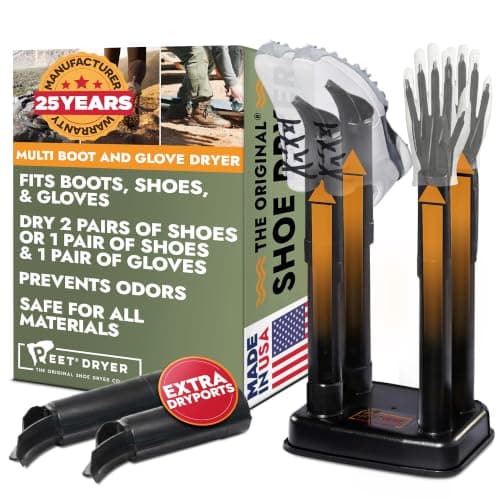
PEET Multi
4 ports
4-8 hours / overnight
72 W
25 years
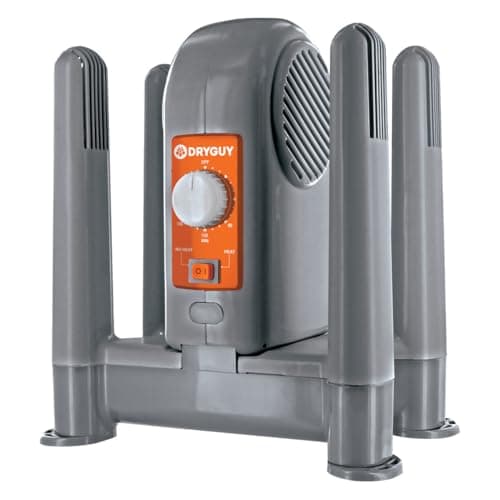
DryGuy Force Dry DX
4 garments
1-2 hours, most garments
Not published
1 year
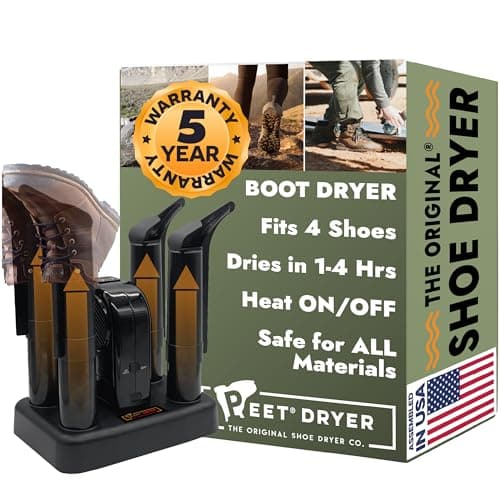
PEET Advantage Plus
4 ports
1-4 hours
220 W with heat
5 years
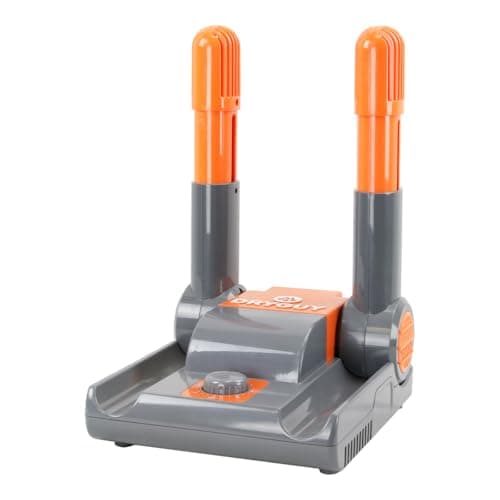
DryGuy Force Dry
2 garments
1-2 hours, most items
Not published
1 year
Boots, liners, gloves and a hat is four ports on a good day. It is also four things with four different drying times.
Why the Multi takes it
Seventy-two watts, four ports, silent, and a twenty-five-year warranty. Run the numbers and it comes out at 10.6 cents for an eight-hour night - 0.072 kW times 8 hours is 0.576 kWh, at the EIA average residential rate of 18.34 cents. Across ninety nights that is $9.51 for two pairs, which is $4.75 a pair, identical to running a single 36-watt Original.
Be clear about what that means, because it cuts both ways: there is no efficiency gain from the extra ports. PEET doubled the element to serve them. What you actually save is an outlet, a footprint and one purchase - not electricity.
Its honest cons are on the card and worth repeating. It is 13.25 inches wide and five pounds, so it wants a shelf rather than a corner. And four ports on a convection element is still an overnight job: if you need any of it dry before bedtime, this is the wrong unit.
The fast pair, and the figure DryGuy will not print
What DryGuy does not publish, for either the DX or the smaller Force Dry, is wattage or amperage. That has two consequences we are not willing to paper over. You cannot compute what it costs to run from the maker’s own data, and you cannot check it against a marginal circuit in a garage or a cabin. A product that runs a heating element and a fan for two hours a night, ninety nights a season, with no published power figure, is asking you to take the running cost on trust. We rank it second rather than first on exactly that, and the fuller argument is in PEET vs DryGuy.
Gloves and boots on the same machine: load them in order
Put the boots on first and give them a head start. Add the gloves later, or accept that the gloves will spend hours in warm air after they are already dry. Overdrying a leather glove does the same thing overdrying a leather boot does - Atsko is explicit that force drying with heat hardens and shrinks leather. On a convection unit at 105 F or below this is a small risk. On anything with a heat setting, it is a real one.
The Advantage Plus, if the evening is the constraint
Four ports and a published one-to-four-hour drying time, which is the fastest thing here that also publishes its wattage. That figure is 220 watts with heat on, 1.833 amps at 120 volts - about six times the Original - and the warranty is five years rather than twenty-five.
The specification that makes it defensible on leather is the published no-heat mode at 0.33 amps. Use that as the default and the heat only when you genuinely need a two-hour turnaround. Buying the fast unit and running heat nightly on leather boots is the most common expensive mistake in this category.
The two-garment unit, and when it is the right answer
The Force Dry is the DX with half the capacity: the same published 105 F cap, the same three-hour auto shut-off, the same one-to-two-hour claim, two garments instead of four. If your actual load is one pair of boots dried fast, it is a smaller box for the same job and it is the sensible buy.
If your load is one pair of boots dried overnight, none of the units on this page are what you want, and the main dryer roundup ranks the two-port options properly.
How to load a four-port dryer
There is a right order, and getting it wrong is why people conclude that multi-port dryers do not work well.
01
Pull everything removable first
Insoles out of the boots, liners out of anything that has them. The insole is the wettest part of the boot and it will not dry inside it. If you have spare ports, the insoles get one.
02
Boots on the tall ports, wet-side down
On most units the two rear or outer ports are the taller ones. Boots go there. Push them down far enough that the port is genuinely inside the boot rather than propping it up from underneath - a boot balanced on the tip of a tube is being heated, not ventilated.
03
Give the boots a head start
An hour on a forced-air unit, or from bedtime on a convection one. A glove holds a fraction of the water a boot does and will be finished long before the boot is.
04
Add gloves last, and take them off first
Gloves go on the short ports once the boots are underway. Pull them as soon as they are dry. Leather gloves left in warm air for hours after they are dry stiffen for exactly the same reason leather boots do.
05
Check the boot from the inside, not the outside
Press the lining near the toe and feel the tongue. Leather that is still cool to the touch is usually still damp. Boots routinely feel dry outside while the interior is not.
Two pairs of boots, or boots plus gloves?
These are not the same load and it is worth deciding which you actually have before buying four ports. Two pairs of boots is four heavy, slow items competing for the same airflow - and on a convection unit, that is genuinely an overnight job with no margin. Boots plus gloves is two heavy items and two light ones, which the same machine handles comfortably.
The cost side is easy to reason about once the wattage is published. On the PEET Multi at 72 watts, a night is 10.6 cents whether you have filled two ports or four - a convection element does not draw more because you loaded more onto it. So the per-garment cost falls the fuller you run it: 5.3 cents each for two items, 2.7 cents each for four. Across a ninety-night season, drying four things a night costs $9.51 in total.
That is the real argument for a multi-port unit and it is an argument about convenience rather than economy - the money involved is trivial either way. Buy it because you have four wet things every evening, not because it saves electricity.
Hats, liners, socks and the rest of the pile
Both makers describe these as garment dryers rather than boot dryers, and the port count is genuinely usable for more than footwear. A hat, a pair of thick socks or a set of glove liners will all sit on a port and dry faster than anything leather.
Two cautions. Anything that drapes over a port rather than fitting onto it can block the airflow to that port entirely, which is a slow way to dry one item and no way at all to dry the others. And a heat-molded ski liner is not an ordinary garment - it belongs in a different conversation, below.
Noise, and where the machine has to live
A four-port unit is a bigger object than a two-port one and it has to stand somewhere permanent, which makes noise a real specification rather than a footnote. The PEET Multi has no fan at all, so it can sit in a hallway or a bedroom without anybody noticing. Both DryGuy units and the PEET Advantage Plus have fans, and a fan running from ten at night in an open-plan apartment is a different proposition from one running in a garage.
This is worth deciding before the purchase, because it interacts with the timer. A three-hour auto shut-off means the noise ends before you go to bed - which is fine if you load the machine at seven, and useless if the boots come off at eleven. A silent convection unit has no such constraint and simply runs until morning.
The extension-tube question
DryGuy ships extension tubes with the Force Dry DX, which is the answer to the most common complaint about four-port units: the ports are short, because they have to be to fit four of them onto one base. On a tall work boot, a short port delivers air to the ankle and leaves the shaft in still air.
PEET solves the same problem differently, by selling separate tall models rather than extensions - the Wader reaches a published 42.5 inches, and which model suits which boot is laid out in which PEET dryer should you buy. If your load is genuinely two tall boots plus two gloves, check the reach before the port count. Reach is the specification that can make a dryer not work at all; ports only decide how many things it works on.
Ski and snowboard gear is a different problem
A ski boot is a sealed plastic shell around a foam liner, and the liner is frequently heat-molded to the owner’s foot. That changes both what is worth buying and what temperature is acceptable, and it is covered separately in the ski and snowboard dryer roundup. If your four ports are going to be two ski boots and two liners, read that first - the port count is the least interesting part of that decision.
The honest summary
If you dry two pairs, or boots plus gloves, and you can wait overnight: the PEET Multi, at $9.51 a season for the pair of pairs, with a twenty-five-year warranty behind it. If you need four garments dry in two hours and you accept that no one can tell you what it costs to run: the Force Dry DX. If you want speed with a published wattage attached: the Advantage Plus, on no-heat unless the evening demands otherwise.
The write-ups
Every pick, in full
01 / Best four-port for the money
PEET
8.6 / 10
PEET Multi Shoe & Glove Dryer
Four ports on 72 watts - two pairs of boots, or a pair plus gloves, for about eleven cents a night.
+Temperature capped at 105 F, gentler than an unregulated heat source
+Four garments at once, with extension tubes for taller boots
What it does not
−No published wattage, so its running cost cannot be computed from the maker's own data
−1-year warranty against PEET's 25
−Fan noise
Skip this one if
You want to know what it costs to run. The maker publishes temperature, timer and dimensions but not watts or amps, and we will not print a number we cannot source.
How it scores, by criterion
Running cost5.0
Capacity9.0
Boot-height reach8.0
Speed9.5
Warranty4.0
Published documentation5.0
03 / Best same-evening turnaround
PEET
8.8 / 10
PEET Advantage Plus 4-Shoe Dryer
The fast one: 220 watts of forced heated air that PEET publishes as a 1-to-4-hour job, with a no-heat mode that drops to a third of an amp.
You dry more than one pair a night, or you want a published wattage figure.
How it scores, by criterion
Running cost5.0
Capacity6.0
Boot-height reach6.0
Speed9.0
Warranty4.0
Published documentation5.0
How these picks were chosen
Everyone in this category says they tested twenty dryers. We have not tested any, and we say so. What we did instead: read the manuals, compile the published specifications, compute the running cost from the manufacturer's own wattage figure, and show the arithmetic so you can check it.
Yes, on any four-port unit. Expect the gloves to finish well before the boots, since they hold far less water. Load the boots first and add the gloves later, or pull the gloves once they are dry rather than leaving them in warm air all night.
What is the best boot and glove dryer?
On published figures, the PEET Multi: four ports on 72 watts, silent, with a twenty-five-year warranty and a computed running cost of about $9.51 for a ninety-night season. If you need one-to-two-hour drying instead, the DryGuy Force Dry DX is the faster option, though DryGuy publishes no wattage for it.
How much does a four-port boot dryer cost to run?
For the PEET Multi it is computable: 72 watts for eight hours is 0.576 kWh, which at the EIA average residential rate of 18.34 cents per kilowatt-hour is 10.6 cents a night, or $9.51 across ninety nights. DryGuy publishes no wattage for its units, so no honest figure can be given for those.
Do four-port dryers dry each boot more slowly?
Not on the PEET Multi, which doubles the wattage to 72 to serve the extra ports rather than splitting a single element four ways. That is also why it costs twice as much to run as a two-port Original - the capacity is real, and so is the power draw.
Are boot dryers safe for leather gloves?
On a convection unit or one with a published temperature cap around 105 F, yes. On any heat setting, the same warning applies to gloves as to boots - Atsko states plainly that force drying with heat hardens and shrinks leather. Pull leather gloves as soon as they are dry.