The constraint nobody mentions: there are no laces to let out. Anything you put in a cowboy boot has to earn its volume, which rules out most of the insoles that win in work boots.
By Scooter M., Enthusiast. Published September 27, 2026.
We earn a commission if you buy through the links on this page, at no extra cost to you. It never changes a ranking, and we recommend products with no affiliate link behind them where those are the right answer. Full disclosure.
Quick picks
The shortlist, ranked
Ranked on published manufacturer specifications and, where a wattage figure exists, computed running cost. Tap any row for the full write-up, including who should skip it.
#
Product
Best for
Score
Price
01
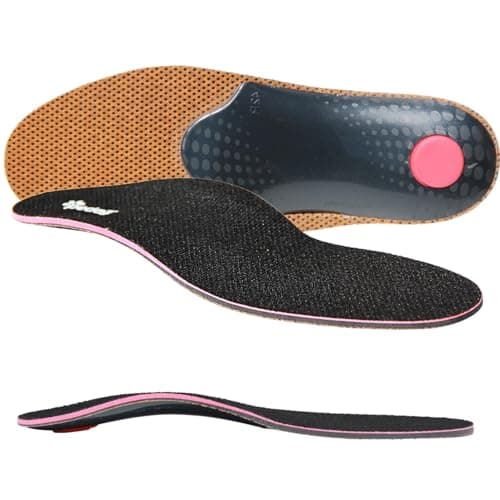
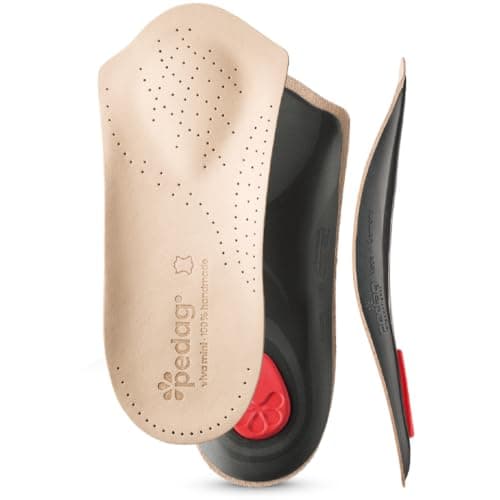
pedag Viva Mini 3/4 Leather InsoleCowboy boots and any snug pull-on boot that cannot spare volume
Scores are ours and editorial. They are never published as review or rating markup, because we have not tested these products.
A cowboy boot is the hardest footwear on this site to fit an insole into, for one structural reason: it is a pull-on boot with a fitted heel and no laces. When you add thickness, a laced boot lets you loosen a hole and carry on. A cowboy boot just lifts your heel slightly out of the pocket it was built around, and that is how a comfort purchase turns into a blister.
So this page ranks on volume before it ranks on support. We have not tested these - no gait lab, no pressure plate - and what we did instead was read what each maker publishes about length, thickness and materials, and score on how well that fits a boot you step down into.
How we judged them
How much volume it takes. The first question, and the reason the winner here is not the winner in our general arch support ranking. A maker that publishes a thickness, even loosely, is telling you something useful.
Length. A 3/4 insole ends before the toes, which means it adds arch support without changing the volume where a cowboy boot is tightest. Full-length insoles do the opposite.
Whether the heel stays seated. A pull-on boot works because your heel sits in a pocket. Anything that raises the foot reduces how deeply it sits.
Published materials. Leather and carbon behave differently from EVA foam in a boot with no ventilation, and the makers that name their materials let you predict that.
Moisture and odor. A cowboy boot has a tall shaft and no lace gap, so it dries slower than anything else we cover - which makes the top cover material a real criterion rather than a footnote.
No medical claims of our own appear here. Where a maker states a clinical claim or a podiatric seal, it is quoted as theirs.
1. pedag Viva Mini - best overall
The one that solves the actual problem. pedag publishes a 3/4-length design that fits “tight dress shoes without crowding your toes”, made from “natural, breathable vegetable-tanned cowhide leather” with “eco-friendly water-based adhesives”, and - the line that matters most here - “at just a few millimeters thin, Viva Mini provides professional-grade orthotic support”.
The support is not token: pedag lists “semi-rigid longitudinal arch support”, “an integrated metatarsal pad that cushions the ball of your foot” and “a soft heel cushion that absorbs impact”. It carries an APMA Seal of Acceptance and is handmade in Germany, in women’s 5-12 and men’s 6-15.
For a cowboy boot that combination is close to ideal. The 3/4 length leaves the toe box alone, the thinness limits how much it lifts your heel, and leather over a fitted insole board is the traditional material inside a western boot anyway.
The honest downside: it is the most expensive option here, and pedag’s own use list is dress shoes, loafers, oxfords and flats - boots are not named on the Mini page, so we are applying it to a case the maker does not specifically claim. It has no forefoot cushioning under the toes by design, it is sold in sizes rather than trim-to-fit, and “a few millimeters” is as precise as the thickness gets.
2. pedag Worker - best for working boots
If the boots are work boots that happen to be western - ranch, feedlot, anything where you are standing on hard ground all day - this is the pedag to buy instead. pedag publishes a “high-tech fiber top layer”, an “interior activated carbon layer”, and a “rigid molded base with integrated heel cushion”, with longitudinal and metatarsal support and a two-zone cushioning system in the heel and forefoot.
Two published details make it relevant to this page specifically. It names “work boots, construction boots, and heavy-duty footwear” as the target - actual boots, not dress shoes. And the carbon layer is there to wick sweat and control odor “inside tightly enclosed boots”, which is exactly what a tall pull-on shaft is. pedag also publishes the sizing workaround: order the next full size up for half sizes and trim the front to fit.
The honest downside: it is full-length with a rigid molded base, which is the opposite of what a snug cowboy boot wants. No thickness figure is published. If your boots are dress-weight western boots rather than working ones, this will very likely be too much insole - start with the Mini.
3. Superfeet All-Purpose Support High Arch - best if there is room
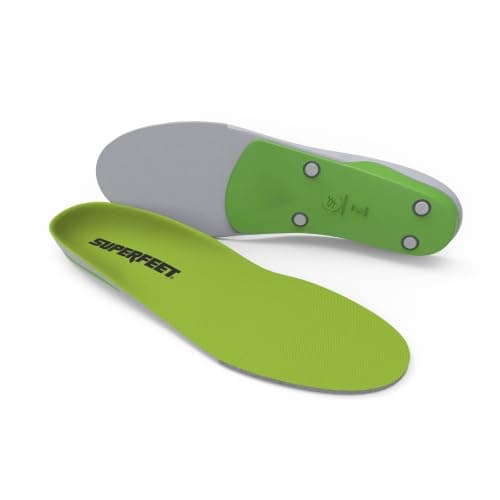
The structured option, and a genuinely good insole - it is second in the arch support ranking - but it is third here because of what it does to volume. Superfeet publishes a high arch profile, a stabilizer cap for structure, a sculpted heel cup, a Moisturewick top cover that “helps reduce odors”, 12 months of performance and a 60-day comfort guarantee.
The heel cup is the part worth thinking about in a western boot. It is designed to “encapsulate and position the heel”, which is a real benefit in a roomy boot and a competing structure in a boot that already has a fitted heel pocket. Superfeet’s own fit guidance is “roomy to moderate fitting footwear with removable insoles”, which is a fair description of a broken-in boot one size generous and not of a snug one.
The honest downside: full-length, trim-to-fit, and the thickest feel of the four in practice. If the boots are already snug it is the wrong buy, and a bad trim is not recoverable. A high arch profile under a foot that does not have one is uncomfortable in a way no break-in fixes.
4. PowerStep Pinnacle - best neutral arch
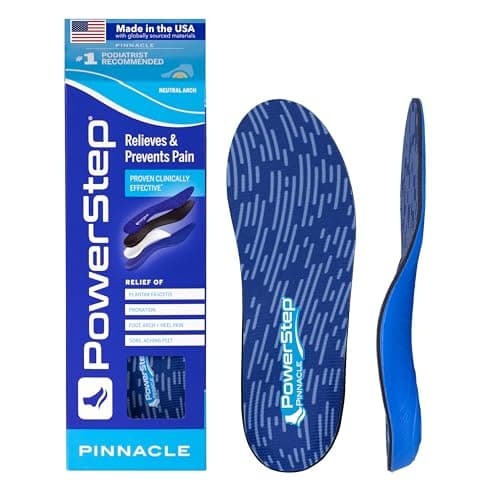
The best-documented insole on the site - a named polypropylene support shell, dual-layer foam over EVA, an odor-control polyester top cover, twelve published sizes, APMA acceptance and a stated 6-months-or-longer service life. If you know you want neutral arch support and your boots have the room, nothing here tells you more about what you are buying.
It earns fourth place on this page purely on fit. Full-length, firm, and built around a deep heel cradle, it is the most insole of the four - which is why it leads the general ranking and trails here.
The honest downside: in a pull-on boot, the most likely outcome of adding a firm full-length insole with a deep heel cradle is heel slip. PowerStep publishes no thickness figure, its intended footwear list is walking, work and casual dress shoes, and it is the priciest per month once you factor the six-month replacement guidance.
No laces means no adjustment. Whatever goes in has to fit the volume the boot already has.
The heel slip problem, and how to test for it
A small amount of heel movement is normal in a new cowboy boot and it reduces as the sole flexes. What is not normal is your heel lifting clear of the pocket because the footbed is now higher than the boot was built for.
01
Pull the factory insole out first
If it comes out, the new insole replaces it rather than stacking on top - that is the difference between adding a couple of millimeters and adding the whole thickness. If it is glued down, only a 3/4 or half insole is realistic.
02
Stand, then walk on a hard floor
Carpet hides heel slip. Ten steps on a hard floor tells you more than standing still for a minute.
03
Check the instep, not just the heel
A pull-on boot grips across the instep. If the insole has made the boot tight over the top of your foot, that pressure will not wear in - it is volume the boot does not have.
04
If it slips, go shorter rather than thinner
A 3/4-length insole adds arch support while leaving the heel pocket and toe box closer to original. That is the whole argument for the Viva Mini at the top of this page.
What an insole will not fix in a cowboy boot
It will not correct a boot that is the wrong size or the wrong width - western boots are sized in a way that punishes guesswork, and no insert rescues a boot that is a size out. It will not stop the shaft rubbing your calf, and it will not fix a worn-through sole or heel, which is a cobbler job on boots worth resoling.
Moisture, odor and the tall shaft
Cowboy boots are the slowest-drying footwear we cover. There is no lace gap to open, the shaft is tall enough to hold a column of damp air, and the lining is usually leather, which holds moisture rather than wicking it away.
Two of the insoles here publish something relevant: pedag’s carbon layer for sweat and odor in “tightly enclosed boots”, and Superfeet’s Moisturewick cover. Both help; neither substitutes for taking the insole out at the end of the day so the boot and the footbed dry separately. The odor mechanism is in why wet boots start to smell, and for a boot that already smells, clean or replace your insoles is the decision.
The other half of keeping a western boot wearable is the leather itself - cowboy boot care has the four-step routine the boot makers publish, including Ariat’s instruction never to dry boots with direct heat.
Which one, in one line each
Standard cowboy boots, arch ache by the afternoon: pedag Viva Mini, 3/4 length, a few millimeters thin.
Western work boots on hard ground all day: pedag Worker, and accept the volume.
Boots with genuine room and a high arch: Superfeet All-Purpose.
Boots with room and a standard arch: PowerStep Pinnacle, the best-documented of the four.
Boots that are already snug: none of them at full length - a 3/4 insole or nothing, because heel slip is worse than mild arch ache.
Why the factory footbed is so thin in a western boot
It is not cost-cutting, or not only that. A traditional western boot is built around a leather insole board over a shank, with the fit worked out for that stack: the heel pocket, the instep grip and the toe room are all measured with a thin footbed in place.
Two consequences follow for anyone adding an insole. The volume you are borrowing was never spare - unlike a running shoe, where a removable foam footbed is an afterthought the manufacturer expects you to replace. And the support you may be missing is under the arch rather than under the heel, because the shank already does something for the middle of the foot that a sneaker’s sole does not.
That is the argument for a thin, semi-rigid, 3/4-length insert over a thick cushioned one: you are supplementing a structure that already exists, not replacing a missing one.
If the boots are too tight once the insole is in
Three options, in the order we would try them, and one thing not to do.
Go shorter. A 3/4 insole leaves the toe box and most of the heel pocket as they were. If a full-length insert is tight, this is the first swap rather than the last.
Remove the factory footbed properly. If it lifts out, it should come out - stacking two footbeds is how most people accidentally lose a whole size of volume.
Accept less support. A thin leather liner does little for the arch but does keep the footbed dry and gives a slightly firmer surface, and in a snug boot that may be all the room allows.
What not to do: rely on the boots stretching around the new insole. Leather gives across the vamp over time, but the heel pocket depth does not change, and heel slip is a blister problem rather than a break-in problem. If the boots already fit properly, keeping the leather conditioned does more for comfort than forcing an insole into a boot that has no room for one.
The write-ups
Every pick, in full
01 / Best overall
pedag
8.7 / 10
pedag Viva Mini 3/4 Leather Insole
A few millimeters of vegetable-tanned leather with a semi-rigid arch - the 3/4 length is what makes it work in a boot with no laces to let out.
+Names the shell material and the arch profile, which most makers do not
+Full length in published sizes - nothing to cut
+Maker states acceptance by the American Podiatric Medical Association
What it does not
−Firm underfoot, and firm takes a week or two to stop feeling strange
−Neutral only - wrong shape for a genuinely high arch
−The most expensive way to solve this on our list
Skip this one if
You know your arch is high - this is a neutral profile, and Superfeet publishes a high one.
How it scores, by criterion
Documented use9.5
Support structure9.0
Fit in a boot8.5
Published composition9.0
Value per month7.0
How these picks were chosen
Everyone in this category says they tested twenty dryers. We have not tested any, and we say so. What we did instead: read the manuals, compile the published specifications, compute the running cost from the manufacturer's own wattage figure, and show the arithmetic so you can check it.
Yes, but volume is the constraint: a cowboy boot is a pull-on with a fitted heel and no laces to loosen, so a thick full-length insole can lift your heel out of its pocket. Pull the factory footbed out first if it comes out, and prefer a 3/4-length insole if the boot is snug.
What kind of insole is best for cowboy boots?
A thin 3/4-length one with real arch support. pedag’s Viva Mini publishes exactly that combination - 3/4 length, a few millimeters thin, semi-rigid longitudinal arch support, vegetable-tanned leather - which is why it leads this page ahead of insoles that win in laced boots.
Will an insole cause heel slip?
It can, and that is the main risk here. Anything that raises your foot reduces how deeply your heel sits in the pocket the boot was built around. Test by walking ten steps on a hard floor rather than standing on carpet.
Are leather insoles better than foam in cowboy boots?
For volume and moisture, leather has real advantages: it is thin, and pedag publishes vegetable-tanned leather with an activated carbon layer for odor in enclosed footwear. Foam gives more cushioning per millimeter but takes more room and holds moisture longer in a boot that dries slowly anyway.
Do insoles help with cowboy boot arch pain?
A structured insole adds support the flat factory footbed does not have, and pedag and PowerStep both publish podiatric seals for theirs. Those are the makers’ claims, not ours - and persistent, diagnosed foot pain is a question for a podiatrist rather than a website.
How do you stop cowboy boots smelling?
Take the insole out at the end of the day so the boot and the footbed dry separately - a tall pull-on shaft is the slowest-drying footwear we cover. Two of the insoles here publish odor-control top covers, which helps, but drying is what removes the moisture the bacteria need.