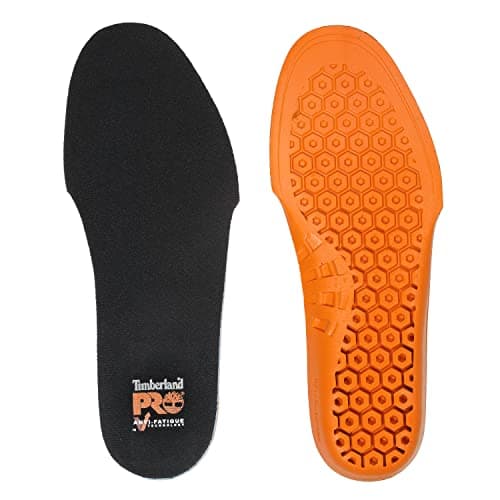
Every other page ranks these on cushioning nobody can measure. We rank them on the things you can actually verify - and on the one move that does more for a work boot than any insole choice.
By Scooter M., Enthusiast. Published September 13, 2026.
We earn a commission if you buy through the links on this page, at no extra cost to you. It never changes a ranking, and we recommend products with no affiliate link behind them where those are the right answer. Full disclosure.
Quick picks
The shortlist, ranked
Ranked on published manufacturer specifications and, where a wattage figure exists, computed running cost. Tap any row for the full write-up, including who should skip it.
#
Product
Best for
Score
Price
01
Timberland PRO Anti-Fatigue Replacement InsoleTwelve-hour shifts on hard floors
Scores are ours and editorial. They are never published as review or rating markup, because we have not tested these products.
Start with the thing almost nobody selling insoles will tell you: buy two pairs and rotate them. A work boot does not get a rest day. The insole is the wettest component in it and the slowest to dry - foam and fabric, compressed against the sole, with no airflow underneath - so a boot worn daily receives a damp footbed every single morning.
Two pairs, alternated, breaks that cycle for the price of the cheapest part of the boot. It does more for how a work boot feels and smells at the end of a fortnight than choosing between any two insoles on this page.
With that said, they are not all the same, and the differences that are actually checkable are worth ranking.
What we ranked on, and what we refuse to rank on
We have not worn these. There is no wear-test panel here, and an insole review claiming to have measured comfort across a twelve-hour shift would be the easiest thing on this page to disprove. So we do not rank on comfort, cushioning or “support” as a feeling. What we rank on:
Does it come out and dry on its own? The single most useful property of a work-boot insole, and the one that decides whether the boot smells. A structured insole dries far faster outside the boot than a glued-in factory footbed ever does inside it.
Published support type. Structured orthotic, cushioning foam, or ventilated foam. That is a stated design category, not an opinion, and it is what should match your feet.
Durability signals. Superfeet publishes a working life - around 500 miles or 12 months, varying with body weight and how often they are worn. Almost nobody else in this category publishes anything, and we mark that down.
Cost of buying two pairs. Because that is the buy we actually recommend, the per-pair price matters twice as much as it looks.
Out of the boot is where an insole dries. In the boot it is the last thing in the building to dry.
The five, side by side
Insole
Type
Published life
Fit
Timberland PRO Anti-Fatigue
Full-length anti-fatigue footbed
Not published
Sized
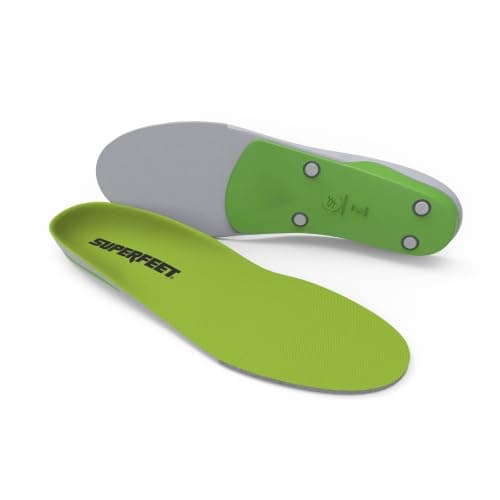
Superfeet All-Purpose High Arch
Structured high-arch support
~500 miles or 12 months
Sized, trim-to-fit
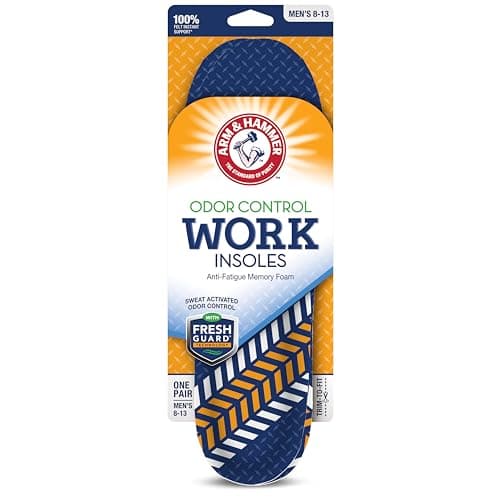
Arm & Hammer Work Boot
Memory foam with odor control
Not published
Trim-to-fit
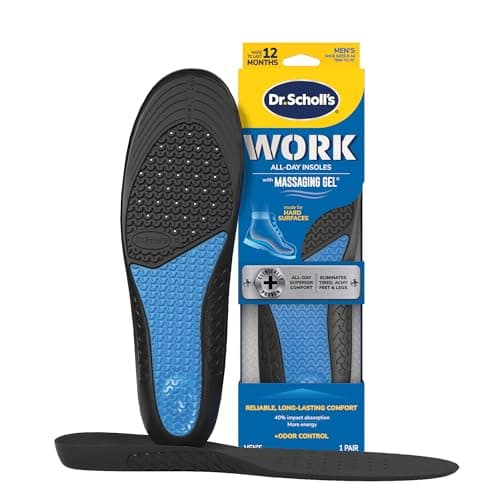
Dr. Scholl’s Work
Cushioning with massaging gel
Not published
Trim-to-fit
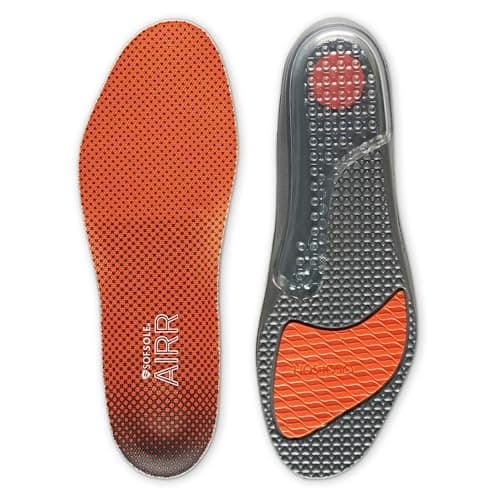
Sof Sole Airr
Ventilated cushioning
Not published
Sized
Why the Timberland PRO takes it
It is the one insole here made by a company that also makes work boots, designed for the specific problem of standing on concrete rather than running on a road. It is a full-length replacement footbed, so it comes out cleanly and dries on its own overnight - which on a daily-worn boot is the property that matters most.
The cons are honest and they are on the card. It takes real volume, so a boot that is already snug with the factory footbed in will feel tight. It is sold in sizes rather than trim-to-fit, so the size has to be right. And Timberland publishes no composition or rated life for it, which is why it does not score top on documentation despite winning the page.
First: is the insole actually your problem?
Worth two minutes before you spend anything, because three different complaints get treated as an insole problem and only one of them is.
Aching feet by mid-shift. That is the insole’s territory, and a replacement footbed is a reasonable first move - particularly if the factory insole is the thin die-cut foam sheet most work boots ship with.
The boot smells. Also the insole’s territory, but the fix is removal and rotation rather than a better insole. A premium footbed left in a damp boot every night smells exactly as fast as a cheap one.
Pressure in one specific spot, or numbness. That is usually fit, not cushioning, and adding volume to a boot that is already tight makes it worse. No insole fixes a boot that is the wrong shape for your foot.
Press the heel area of your current insole with a thumb. If it stays compressed, the cushioning is gone and this page is for you. If it springs back and the complaint is smell, the answer is cheaper than a new insole - it is a second pair and a drying routine.
Safety toes, and the volume problem
A steel or composite toe cap is a fixed shape inside the boot with a hard edge where it ends. Adding a thick footbed lifts your foot toward that edge, and the usual result is pressure across the top of the toes that was not there before.
Two practical rules. Always take the original insole out rather than layering a new one on top - stacking two footbeds is the single most common way people make a safety boot uncomfortable. And if you are near the top of your size range already, favor a thinner trim-to-fit cushioning insole over a structured one, because the structured options are the thickest things here.
The other constraint people forget is that some workplaces specify metatarsal or electrical-hazard rated footwear. We could not source a published statement from any insole maker about whether a replacement footbed affects those ratings, so we are not going to guess either way - if your boots carry a rating you depend on, ask the boot manufacturer before you change what is inside them.
The one with a published lifespan
Superfeet is second because it is the only maker here that will commit to a number. Its FAQ gives around 500 miles or 12 months, caveated by body weight, biomechanics and frequency of wear. On a page where every other product publishes nothing, a maker willing to tell you when to replace its own product is doing something the rest are not.
It is a firm structured insole rather than a cushion, which is right for some feet and wrong for others - and it is the most expensive thing here by a distance, which matters doubly if you follow the rotation advice. Superfeet also publishes the wash method: mild soap and warm water, air dry away from heat, and in capital letters, do not machine wash or dry.
The rotation, in practice
Buy two pairs. Pull the insoles every evening when the boots come off, stand them somewhere with moving air, and put yesterday’s dry pair in tomorrow morning. Allow a full day - foam holds water long after the surface feels dry.
This is why the cheap insoles on this page are not the weak picks. At the lower price you can buy two pairs and still spend less than one pair of the structured option, and the rotation is worth more than the upgrade. The washing method and the replace-vs-clean decision are in clean or replace your boot insoles.
The one that is also an odor product
Arm & Hammer builds baking soda into the footbed rather than asking you to spray something into the boot afterwards. On a work boot that is the right place for it: the footbed is where the sweat actually lands, and the Cleveland Clinic’s description of why feet smell is bacteria in a warm, dark, damp environment- which is a description of the space directly under your foot.
It is cheap enough that buying two pairs is genuinely easy, which is the main reason it is third. Its limits are the limits of memory foam: it compresses within months of daily wear, and there is little arch structure. Treat it as a consumable rather than an investment.
On “anti-fatigue” claims
Several insoles in this category are sold on reducing fatigue over a long shift, and we want to be straight about what we can and cannot say about that.
What is plausible and mechanical: a footbed that returns some energy and spreads load over more of the foot will feel different at hour ten than a flat foam sheet that has packed down to nothing. Anyone who has replaced a dead insole recognizes that difference.
What we cannot tell you is how much, or how it compares between brands, because none of the makers here publish a test method or a measured figure we could check. So we rank the Timberland PRO first on fitness for the job - it is a full-length replacement footbed from a work-boot maker - and not on a fatigue claim we have no way to verify. That distinction is the whole reason this page exists in the shape it does.
The cheap replacement, and the ventilated one
The Dr. Scholl’s work insole is the supermarket default and there is nothing wrong with that. Trim-to-fit, available everywhere, cheap enough to rotate. Foam compresses within months and there is no published composition, so buy it knowing it is a consumable.
The Sof Sole Airr is the pick if your boots have no lining ventilation at all - a rubber-bottomed or fully insulated work boot, where nothing moves through the upper. It is a cushioning insole rather than an orthotic, which our own card says plainly: skip it if you want firm support.
Trim-to-fit, without ruining a pair
Most cushioning insoles are sold oversized and expect you to cut them down, and most people cut them wrong on the first try. The method that works: take the original factory insole out, lay it on top of the new one heel-to-heel, and trace around the toe end only. Never trim the heel - the heel cup is the part doing the work.
Cut slightly outside the line rather than on it. An insole a shade too long buckles at the toe and you can always take another millimetre off; one cut too short slides forward in the boot and there is no fixing it. Do one, fit it, wear it around the house, then do the second.
What an insole cannot fix
If the boot itself is still damp every morning, no insole solves it - you are swapping the wettest component in a wet boot. The order of operations is to get the boot dry between wears first, then rotate footbeds, then worry about deodorizers.
For a boot that never gets a day off, that means moving air overnight or a dryer. The work-boot case specifically is covered in the work boot dryer roundup, and why the damp is what produces the smell in the first place is in why wet boots start to smell.
One more honest limit: none of these are medical devices, and none of the makers here publish clinical claims we could check. If you have a diagnosed foot problem, that is a conversation with a professional rather than a purchase from a list.
What we would actually buy
Daily work boots on hard floors: the Timberland PRO, and a second pair of something cheap to rotate with it. Feet that want real arch structure and a published replacement interval: Superfeet, accepting the price. A tight budget: two pairs of the Arm & Hammer, which costs less than one pair of most things here and gets you the rotation, which is the part that actually works.
If your problem is specifically sweat and smell rather than comfort, the moisture-first ranking is in the best insoles for sweaty feet.
The write-ups
Every pick, in full
01 / Best all-round work insole
Timberland PRO
8.2 / 10
Timberland PRO Anti-Fatigue Replacement Insole
The work-boot insole with a boot maker's name on it, built for standing on concrete rather than running on a road.
You want a firm orthotic - this is a cushioning insole.
How it scores, by criterion
Documented use5.5
Dries independently8.5
Ease of use9.0
Published composition4.5
Value per pair8.5
How these picks were chosen
Everyone in this category says they tested twenty dryers. We have not tested any, and we say so. What we did instead: read the manuals, compile the published specifications, compute the running cost from the manufacturer's own wattage figure, and show the arithmetic so you can check it.
For daily wear on hard floors, a full-length replacement footbed from a work-boot maker such as the Timberland PRO anti-fatigue insole - it comes out and dries on its own, which is the property that decides whether the boot smells. If you want a published replacement interval, Superfeet gives around 500 miles or 12 months.
How often should you replace work boot insoles?
Superfeet publishes around 500 miles or 12 months for its own, varying with body weight and how often they are worn - a reasonable baseline for any insole. Replace sooner if the heel area stays compressed after you press it with a thumb, or if the layers are separating.
Do insoles help with work boot odor?
Removable ones do, for a mechanical reason rather than a chemical one: the insole is the wettest part of the boot, and taking it out lets it dry properly instead of sitting damp under your foot. Owning two pairs and rotating them does more than any deodorizer.
Will new insoles make my work boots too tight?
A structured or full-length footbed takes real volume, so a boot that is already snug with the factory insole in will feel tighter. Take the original insole out first rather than layering, and if the boot is still tight, a thinner trim-to-fit cushioning insole is the safer buy.
Are expensive insoles worth it for work boots?
Sometimes - a structured insole holds its shape far longer than foam, and one maker publishes a lifespan you can hold it to. But if the budget is fixed, two cheap pairs rotated daily beat one expensive pair worn every day, because the boot then never receives a damp footbed.