Every dryer here is judged on what its maker publishes about weight, size and power draw. The most useful thing on this page is the limit: a travel dryer handles damp, and no amount of marketing changes that.
By Scooter M., Enthusiast. Published September 6, 2026.
We earn a commission if you buy through the links on this page, at no extra cost to you. It never changes a ranking, and we recommend products with no affiliate link behind them where those are the right answer. Full disclosure.
Quick picks
The shortlist, ranked
Ranked on published manufacturer specifications and, where a wattage figure exists, computed running cost. Tap any row for the full write-up, including who should skip it.
#
Product
Best for
Score
Price
01
PEET Power Cell Portable DryerTravel, hunting camps, a locker
Scores are ours and editorial. They are never published as review or rating markup, because we have not tested these products.
Start with the limit, because every page in this category buries it: a portable dryer is sized for damp boots, not soaked ones. The PEET Power Cell draws 12 watts on PEET’s own spec sheet. A full-size PEET Original draws 36. A soaked boot holds well over a pound of water, and moving that much moisture on a third of the power takes correspondingly longer - or does not finish.
That is not a reason to skip one. It is the reason to buy the right one. If your boots come off damp at the end of a hunting day and go back on at dawn, a 12-watt unit that packs inside the boot is genuinely the correct product. If they came off full of creek water, nothing on this page will save your morning and you want the no-dryer method plus as much moving air as the room can give you.
What we ranked on
There is no test bench behind this list. What there is, is a set of questions each option either answers with a published figure or fails to answer at all - and we say which.
Published weight and packed size. “Portable” is a marketing word until somebody prints dimensions. Two of the five here have them on the manufacturer’s page; the rest we say so about.
Published power draw. Watts tell you both what it costs and, roughly, how much water it can move in a night. Where a maker publishes no wattage we do not estimate one - we mark it unpublished and score it down.
Does it need mains power at all? A hotel room has outlets. A tent does not. This is the question that decides whether the last pick on the list is actually the right one for you.
What it can honestly handle. Damp, wet, or soaked. Most of the disappointment in this category is a damp-rated product bought for a soaked-boot problem.
Away from home, air movement is still doing most of the work. A portable dryer supplements it; it does not replace it.
The five options side by side
Option
Published power
Published size or weight
Honest ceiling
PEET Power Cell
12 W
1 lb; 1.75 x 2 x 7 in
Damp boots overnight
DryGuy Simple Dry
Not published
10.83 x 6.1 x 10.31 in
Wet boots overnight
DryGuy Force Dry
Not published
Not published; two garments
Wet boots in 1-2 hours, per DryGuy
PEET Original
36 W
2.5 lb; 22 in tall
Soaked boots overnight
Cedar shoe trees
None
A pair fits in a boot
Residual moisture only
Why the Power Cell wins on the terms this page is about
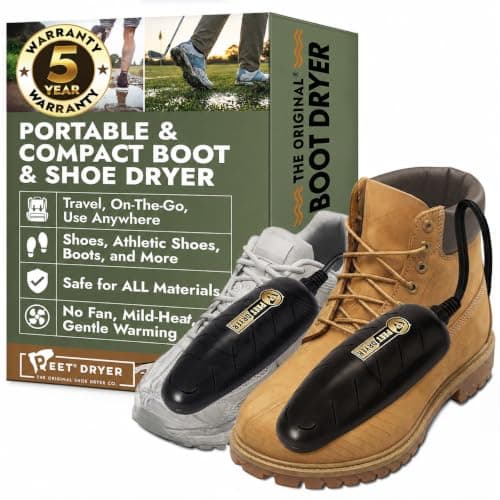
One pound, and PEET publishes the dimensions: 1.75 by 2 by 7 inches. That is small enough to travel inside the boot it is going to dry, which is the whole argument. At 12 watts it costs under two cents for an eight-hour night - 0.012 kW multiplied by 8 hours is 0.096 kWh, and at the EIA average residential rate of 18.34 cents per kilowatt-hour that is 1.8 cents. Across ninety nights it is $1.58. You will spend more on the first tank of gas to the trailhead.
Its honest problems are two. It goes out of stock often, which is not the maker’s fault but is your problem in October. And PEET warrants it for five years rather than the twenty-five that the mains-powered convection line carries, which is a reasonable signal about what it is built to do.
The two DryGuy units, and the documentation gap
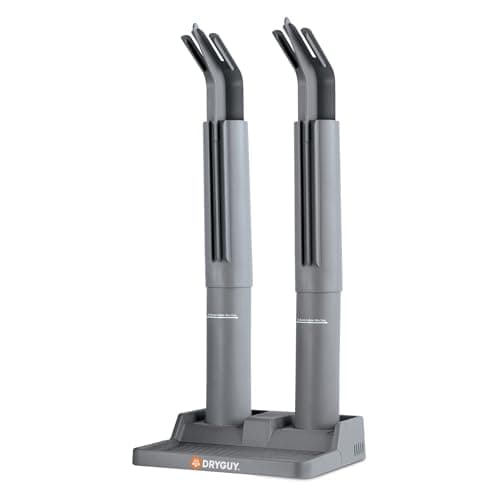
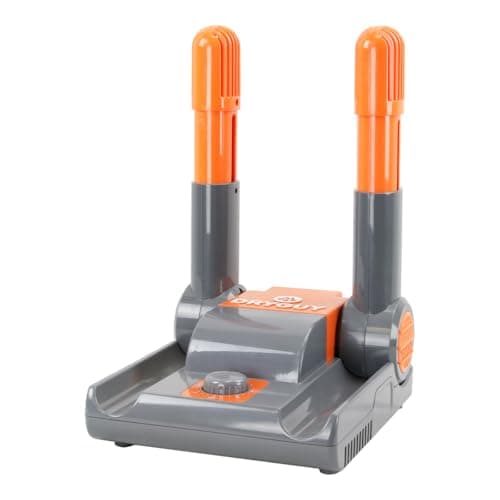
The Simple Dry is a thermal-convection stand with no moving parts in a footprint of about 11 by 6 by 10 inches, and DryGuy publishes a dry time of eight hours or less. The Force Dry is the fan version: two garments, a 105 F temperature cap, a three-hour auto shut-off, and a published one-to-two-hour dry time.
Both are genuinely compact and both have the same defect from our point of view: DryGuy does not publish wattage for either one. That means the running cost cannot be computed from the maker’s own data, and we will not print a number we cannot source. It also means you cannot check whether the fan model is going to trip a marginal circuit in a cabin. We score both down for it rather than quietly ignoring it, and if that documentation matters to you, the comparison is laid out in PEET vs DryGuy.
The 105 F cap is a feature, not marketing
DryGuy publishes a maximum of 105 F on its forced-air units. That matters because the damage in this category comes from heat, not from air. Atsko is explicit that force drying with heat causes leather to harden and shrink, and Blundstone tells you never to dry boots by an artificial heat source. A published ceiling is a manufacturer accepting a constraint in writing. A hair dryer in a hotel room has no such ceiling, which is why it is the worst thing in the room to point at your boots.
When the honest answer is a full-size dryer
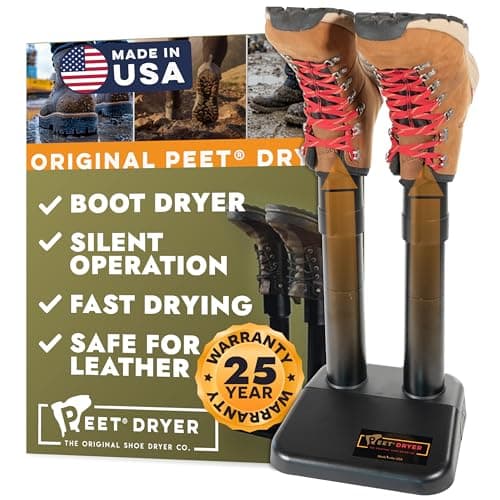
The PEET Original is on this list at fourth place for a reason that has nothing to do with travel: at 2.5 pounds it moves between rooms easily, and a lot of people searching for a portable dryer actually want one they can carry from the mudroom to the garage rather than one that fits in carry-on. It draws the same 36 watts everywhere, it is silent, and PEET warrants it for twenty-five years. If your real constraint is storage rather than transport, buy this and stop reading. The full ranking is in the boot dryer roundup.
Twelve watts, thirty-six watts, or none. The wattage is the honest proxy for how much water the thing can move.
The no-power option, which is not a consolation prize
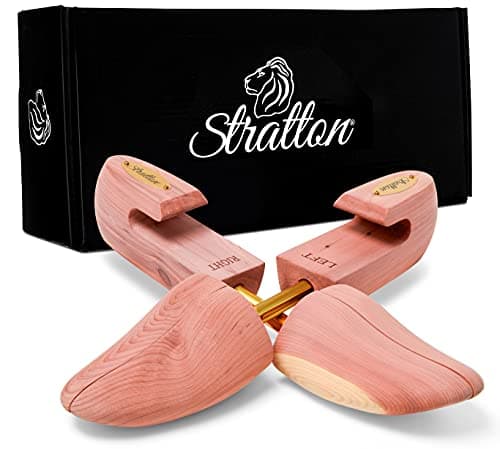
Unfinished cedar trees weigh nothing, need no outlet, and absorb residual moisture while holding the boot’s shape. In a tent, a truck cab overnight, or a hut with no power, they are not the fallback - they are the only thing on this list that works. Their limit is real and we state it on the card: a tree cannot move meaningful water out of a saturated boot. Dry the boot first by whatever means you have, then insert. More on format and fit in the cedar shoe tree roundup.
Paired with a boot left open, laces out, tongue folded back, in whatever moving air exists, cedar covers the last third of the drying that a 12-watt element would otherwise spend all night on. That combination is what most experienced travelers actually run, and it costs nothing to power.
What none of these do
None of them dry a soaked boot in an hour. The fastest published figure on this page is DryGuy’s one-to-two hours for the Force Dry, and that is for “most items” rather than a saturated leather work boot. Our own read of the published numbers across the category is laid out in how long boots actually take to dry, and the honest summary is that soaked leather is an overnight job whatever you plug in.
None of them are a reason to pack wet boots into a sealed bag for the trip home, either. A closed bag with a damp boot in it is the exact condition that produces both the smell and, over a longer trip, visible growth. Pull the insoles, keep the boot open, and give it air.
Camps, lockers and trucks
Three situations come up constantly in this category and they want different answers. A hunting camp usually has power but no space and no tolerance for noise at 4 am, which points at a silent convection unit or the Power Cell. A ski locker often has neither power nor supervision, which points at cedar and a well-opened boot, because anything with an element is a fire-policy problem in a shared locker room.
A truck cab is the awkward one. It has warmth and it has a door you can leave ajar, and between them that is most of what drying requires - but it also has a closed cabin overnight, which is the exact sealed, still, humid environment that produces the smell you were trying to avoid. If the boots live in the truck, crack a window and pull the insoles out onto the dash, which does more than any twelve-watt element will.
Drying boots in a hotel room, with nothing
Worth writing down because it is the situation most of this page is really about, and because the routine matters more than the appliance. Take the insoles out and stand them separately - they are the wettest component in the boot and the slowest to dry, and inside the boot they will still be damp in the morning whatever else you do.
Then unlace fully, fold the tongue right back, and open the boot as wide as it will go. A laced boot dries from the outside in and the interior stays sealed. Stand them somewhere air is actually moving - near the room’s air conditioning outlet is usually the best spot in a hotel, and it is free.
What not to do is the part that costs money. The wall-mounted hair dryer is the single worst object in the room to point at leather: Atsko states that force drying with heat causes leather to harden and shrink, and a hair dryer has no published temperature ceiling at all. Neither does a radiator, a car heater vent or the hot air coming off a wood stove at a hunting camp. The damage is cumulative and it is not reversible.
Newspaper, if you can find any, is genuinely useful as an absorbent that you change rather than as a one-time stuffing. The method - and the reason it fails when people do it wrong - is in drying boots without a dryer.
On 12-volt and truck-cab dryers
A common search here is for something that runs off a vehicle outlet, and we want to be straight about what we could and could not verify. The PEET Power Cell is a mains unit - PEET publishes 0.01 amps at 120 volts for it - so it needs an outlet, not a cigarette lighter socket.
There are 12-volt DC boot dryers on the market. We have not put one on this list because we could not source a manufacturer-published wattage, current draw or drying time for any of them, and this site does not rank a product on specifications it cannot read on the maker’s own page. If you need one, buy it on the retailer’s return policy rather than on a specification, and check the fuse rating of the socket you plan to run it from.
What this costs to run
Only two units here publish a wattage, so only two can be costed. The Power Cell is 1.8 cents a night and $1.58 across a ninety-night season. The PEET Original is 5.3 cents a night and $4.75 across the same season. Both figures use the EIA average residential rate and the arithmetic is on each product card. If your rate is different - and in New England or California it will be - the running-cost calculator takes your own number.
For the two DryGuy units there is no honest figure to give. That is not a rhetorical point: it is the reason they sit below a $1.58-a-season unit in a ranking that weights published documentation.
The write-ups
Every pick, in full
01 / Best for a suitcase
PEET
7.6 / 10
PEET Power Cell Portable Dryer
Twelve watts and a pound in weight - a hotel-room and truck-cab dryer, not a mudroom one.
+Sanding them lightly once a year restores the aroma
+No power, no consumables
What it does not
−Useless on a genuinely wet boot
−Varnished trees do nothing - they must be unfinished
−One pair per pair of boots gets expensive
Skip this one if
The boots are soaking. A tree cannot move enough water out of a saturated boot; dry it first, then insert.
How it scores, by criterion
Documented use6.5
Moisture handling7.0
Shape retention9.5
Published composition6.0
Value per pair8.0
How these picks were chosen
Everyone in this category says they tested twenty dryers. We have not tested any, and we say so. What we did instead: read the manuals, compile the published specifications, compute the running cost from the manufacturer's own wattage figure, and show the arithmetic so you can check it.
On damp boots, yes. On soaked ones, not within a useful timeframe. The PEET Power Cell publishes 12 watts against 36 for a full-size convection dryer, and a boot that has taken on real water needs the larger element or a longer night. Match the product to how wet the boots actually get.
What is the smallest boot dryer you can travel with?
Of the units whose makers publish dimensions, the PEET Power Cell is the smallest at 1.75 by 2 by 7 inches and one pound - small enough to pack inside the boot. DryGuy publishes a footprint of about 11 by 6 by 10 inches for the Simple Dry, which is a suitcase item rather than a boot-pocket one.
Can you leave a portable boot dryer on all night?
PEET’s own FAQ describes its non-fan dryers as a four-to-eight-hour or overnight job, which is how they are designed to be used. DryGuy’s forced-air units carry a published three-hour auto shut-off instead. Follow whichever the maker of your unit publishes rather than a general rule.
Is a 12 watt boot dryer enough?
For a damp boot overnight, yes. For a soaked one, no. Twelve watts is about a third of the element in a full-size convection dryer, and drying is bounded by how much energy you can put into evaporating water. It is a maintenance dryer, not a rescue dryer.
What can you use instead of a portable boot dryer?
Pull the insoles, unlace the boots fully, fold the tongues back, and stand them where air is moving. Unfinished cedar trees take the residual moisture afterwards. That routine costs nothing and gets a damp boot most of the way there overnight.