An oil is the most powerful thing you can put on dried-out leather and the easiest to overdo. These five are ranked on published claims, with the softening risk stated on every one.
By Scooter M., Enthusiast. Published September 21, 2026.
We earn a commission if you buy through the links on this page, at no extra cost to you. It never changes a ranking, and we recommend products with no affiliate link behind them where those are the right answer. Full disclosure.
Quick picks
The shortlist, ranked
Ranked on published manufacturer specifications and, where a wattage figure exists, computed running cost. Tap any row for the full write-up, including who should skip it.
#
Product
Best for
Score
Price
01
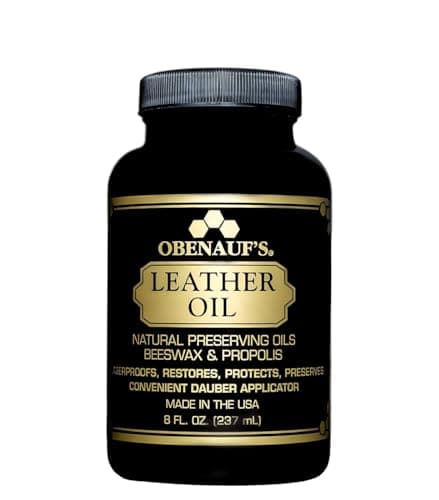
Obenauf's Leather OilLeather boots in moderately wet or dry, dusty conditions
Scores are ours and editorial. They are never published as review or rating markup, because we have not tested these products.
An oil is not a stronger conditioner. It is a different intervention with a different risk: it keeps migrating through the leather after you have finished, it darkens permanently, and the failure mode is a boot that has gone soft and stopped supporting your ankle. Used on the right boot it is the best thing in this category. Used on a hiking boot every month it will ruin it.
We have not tested these. No soak rig, no flex tester, no before-and-after photographs of boots we do not own. What we did is read what each maker publishes, rank on that, and be specific about who should not buy each one.
How we judged them
What the maker publishes. Ingredients, intended leathers, a method, an interval, a coverage figure. Most of this category publishes two of those five; one product here publishes four.
Which leather it is actually for. Oil-tanned work leather, dress calf and vegetable-tanned tooling all behave differently, and the makers that name the leather are saving you a mistake.
What it does to the color. Every oil here darkens. The question is by how much and whether the maker admits it.
What it does to structure. The honest risk in this category. An oil that keeps softening is a feature on a stiff old boot and a defect on a boot you stand in all day.
Where it can go that a paste cannot. Soles, welts, tooling and the inside of a seam are the cases where a liquid earns its place.
Read this before you buy any of them
Oil is not reversible. You cannot take it back out of leather, the color change is permanent in practice, and over-softened leather does not firm up again. Start with less than you think, do one thin coat, and wait a day before deciding whether the boot needs more. Every maker on this page says some version of that, and it is the single most ignored instruction in boot care.
1. Obenauf’s Leather Oil - best documented
Obenauf’s publishes more about this oil than anyone else here publishes about theirs, which is why it leads a page that ranks on documentation. The product page and FAQ give you the components - the same natural oils, propolis and beeswax as its Heavy Duty LP paste, at a different ratio of wax to oil - what it is not made with (no petroleum, solvents, paraffin or mink oil), an interval of every three to six months, and a method with a time limit: allow up to one hour, then buff off the excess.
It also publishes the most useful warning on this page, which is about timing rather than quantity: the final color can take seven days to show, because the oil is still migrating through the fiber layers. That is the honest reason not to judge a treatment on the evening you did it.
The honest downside: it darkens, the maker says so, and a week is a long time to wait to find out how much. The instruction “do not saturate” is doing real work - this is an easy product to over-apply because it goes on so readily. And if what you want is a barrier rather than conditioning, the paste version of the same formula is the better buy; our review of that covers when to choose which.
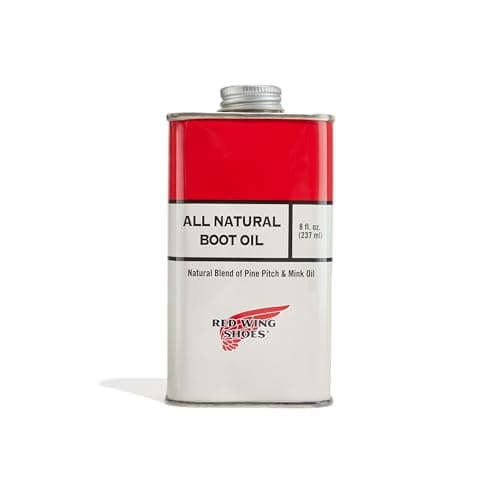
2. Red Wing All Natural Boot Oil - best for oil-tanned boots
The pick when you know what your boots are made of. Red Wing publishes that this oil “blends pine pitch and mink oil into a solution that conditions Red Wing oil-tanned leathers”, and it names them: Harness, Oil Slick, Legacy and Oro-iginal.
That specificity is rare and it is worth paying for. Oil-tanned leather is already carrying oils and waxes from the tannery, and a treatment formulated by the company that tanned it is a better-matched product than a general-purpose oil - particularly the pine pitch component, which is the same idea as the pine tar in Huberd’s Shoe Grease.
The honest downside: Red Wing states it “may initially darken leather”, which on a lighter oil-tanned boot such as Oro-iginal is a visible change. The named-leather list is also a limit as much as a feature - nothing on the page tells you how it behaves on a chrome-tanned dress boot, and we are not going to guess. No interval or coverage figure is published.
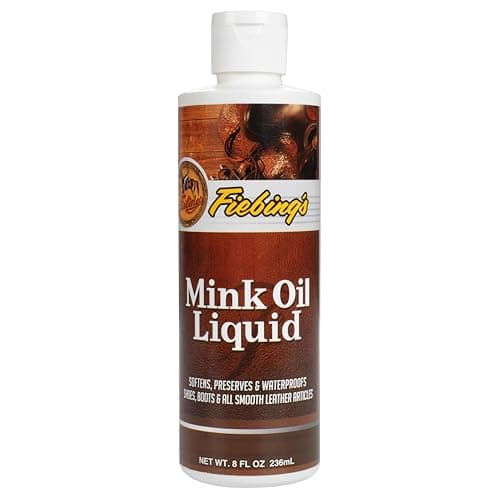
3. Fiebing’s Liquid Mink Oil - best for thin, even coats
Mink oil in a pouring formula rather than a paste, and on a product whose main risk is overdoing it, that is a genuine advantage: a liquid spreads thin far more easily than a paste that has to be worked warm. It is the same active idea as the mink oil paste, in a form that goes into seams and welts without being forced.
The honest downside: that same runniness is the problem. It goes into stitching and welts whether you meant it to or not, and once it is in the seam it is in the seam. Fiebing’s publishes no composition for it on the listing we can source, and like every mink oil it darkens. If you want the reasoning about mink oil generally - including the boots it is wrong for - mink oil vs leather conditioner is the argument in full.
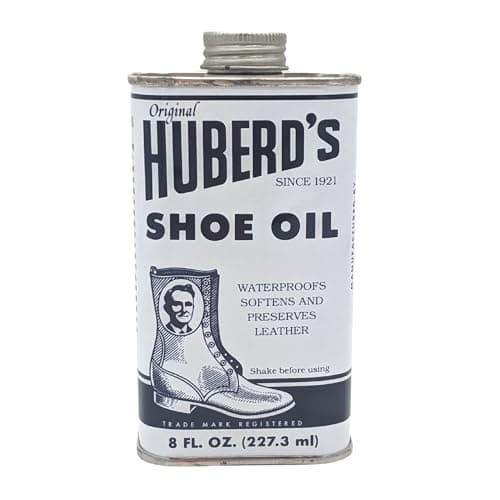
4. Huberd’s Shoe Oil - best for leather soles
The specialist. Huberd’s says its Shoe Oil “with beeswax offers conditioning and waterproofing of leather in an easy pouring formula”, and that it was originally designed for waterproofing leather soles, with “a bit of grip” that suits soles, saddle and tack, and tooling.
A leather-soled boot in wet weather is a real problem that most of this category ignores: the sole soaks, then wears fast, and a paste cannot be worked into the underside of a boot you are standing on. A pouring oil made for that job is the right tool, and the grip note matters because an oiled leather sole on a wet pavement is otherwise a hazard.
The honest downside: Huberd’s publishes very little otherwise - no full ingredient list beyond beeswax, no sizes, no interval, no coverage. The method it does publish asks you to let it soak in for several hours, so this is an overnight job. And it shares the family trait: the pine-tar lineage means a smell, and Huberd’s says nothing about how long it lasts.
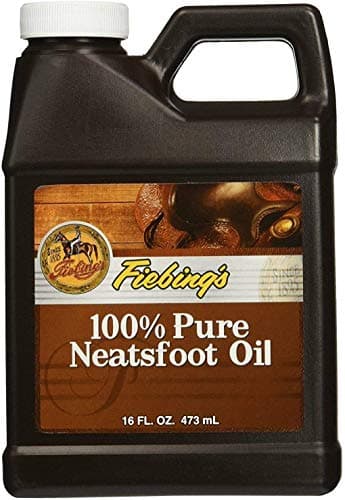
5. Fiebing’s 100% Pure Neatsfoot Oil - best for rescuing hard leather
The most powerful and the most dangerous thing on this page. Pure neatsfoot oil penetrates deeper than any paste and it is the traditional answer to leather that has gone hard - old boots found in a garage, a pair that got soaked and dried by a radiator, tack that has not been touched in a decade.
It is ranked fifth not because it works badly but because it works relentlessly. The oil keeps migrating and the leather keeps softening for far longer than one application suggests, which is exactly what a rescue case needs and exactly what a serviceable work boot does not.
The honest downside: it darkens permanently and substantially, it is easy to turn a boot floppy, and it is not for suede, nubuck or any finish you want to keep. Fiebing’s publishes the product and the purity, but no interval, no coverage and no method detail beyond the obvious. If you are weighing it against the other traditional oil, that comparison is already written up in mink oil vs neatsfoot oil.
Oil is for leather that has dried out, not for leather that is merely dirty. Clean first and see what you actually have.
How to apply an oil without ruining the boot
01
Clean and dry the boots first
Oil drives whatever is on the surface into the leather. Every maker here specifies clean leather, and most specify dry - cleaning leather boots is the first half of any oiling job.
02
Test where nobody looks
The tongue or the inside of the shaft. Every oil on this page darkens, and Obenauf’s adds that the true color can take seven days to appear - so test, then wait, then decide.
03
One thin coat, applied by hand
Warm fingers or a cloth, a thin even layer, extra attention to the flex crease and the welt. Resist the urge to keep going while the leather is still drinking it in - that is how boots end up saturated.
04
Wait, then buff off the excess
Obenauf’s says up to an hour; Huberd’s says several hours. Whatever is still sitting on the surface at the end of that window is surplus and comes off with a cloth.
05
Judge it a week later, not that night
Color and stiffness both keep changing as the oil migrates. If the boot still feels dry in seven days, do a second thin coat then.
Oil, conditioner or wax - which does your boot actually need?
The three do different jobs and buying the wrong one is the most common mistake we see in this category:
Oil penetrates and softens. For leather that has gone hard, and for soles and tooling. Permanent, and the one to be careful with.
Conditioner feeds and maintains without the depth of an oil. For boots in normal use twice a year - the conditioner roundup ranks those, and Leather Honey is the one that publishes its coverage.
Wax sits in the surface and keeps water out. It conditions little and protects a lot - the leather waterproofing roundup is that shelf.
If the boots are stiff and soaking through, the order is oil first, let it settle for a week, then wax on top. Doing it the other way around means the oil never reaches the leather.
Which one, in one line each
You want published numbers: Obenauf’s Leather Oil.
Red Wing oil-tanned boots: Red Wing All Natural Boot Oil.
You are nervous about over-applying: Fiebing’s Liquid Mink Oil, thin coats.
Leather soles or tooled leather: Huberd’s Shoe Oil.
A hard, dried-out pair you are rescuing: pure neatsfoot oil - and accept the color and the softening.
And if the boots are simply dry rather than hard, consider not using an oil at all. How often to condition boots makes the case that most boots are treated too often rather than too rarely, and an oil is the treatment where that mistake costs the most.
Storing an oil, and how long it keeps
None of these makers publishes a shelf life, which is worth knowing before you buy the largest bottle on offer. Natural oils can go rancid, and a part-used bottle kept somewhere warm for years is not the same product you bought.
What we would do, absent published guidance: buy the size you will use within a couple of years rather than the best value per ounce, keep it capped and out of direct sun, and smell it before it goes near a boot. A 16 oz bottle of neatsfoot oil is a lot of oil for one pair of boots treated twice a year.
The write-ups
Every pick, in full
01 / Best documented
Obenauf's
8.2 / 10
Obenauf's Leather Oil
The liquid version of Heavy Duty LP - the same oils, beeswax and propolis at a higher ratio of oil, pitched by its maker at moderately wet and dry conditions rather than mud.
+The classic answer for leather that has gone board-stiff
+A 16 oz bottle is an enormous amount of treatment for the money
What it does not
−Darkens leather permanently, usually a lot
−Keeps softening over time - easy to overdo and end up with a floppy boot
−Not for suede, nubuck or anything with a finish you want to keep
Skip this one if
The boots have to hold their shape. Neatsfoot oil keeps migrating and keeps softening, and it darkens permanently.
How it scores, by criterion
Documented use6.5
Penetration9.5
Ease of use7.0
Published composition7.5
Value per bottle9.5
How these picks were chosen
Everyone in this category says they tested twenty dryers. We have not tested any, and we say so. What we did instead: read the manuals, compile the published specifications, compute the running cost from the manufacturer's own wattage figure, and show the arithmetic so you can check it.
For most people, Obenauf’s Leather Oil - it publishes its components, an interval of three to six months, a method and a warning that the final color takes seven days to show. For Red Wing oil-tanned leathers, Red Wing’s own boot oil is the better-matched product.
Does boot oil darken leather?
Yes, every oil on this page does, and the makers say so - Red Wing states its oil “may initially darken leather” and Obenauf’s says the true color can take a week to appear. If the shade matters, use a conditioner sold on not darkening instead.
Can you use too much oil on boots?
Easily, and it is the main risk in this category. Oil keeps migrating and keeps softening, so an over-oiled boot goes slack and stops supporting the ankle. One thin coat, then wait a week before deciding on a second.
Oil or conditioner for dry boots?
Conditioner for leather that is dry but still flexible; oil for leather that has gone genuinely hard. Oil penetrates deeper and softens more, which is a rescue treatment rather than routine maintenance.
Can you oil suede or nubuck boots?
No. An oil mats the nap and the change is not reversible. Napped leather wants brushes, erasers and a spray - the suede and nubuck cleaner roundup covers the right kit.
How long does boot oil take to dry?
Obenauf’s says to allow up to an hour before buffing off the excess; Huberd’s says several hours. Either way the leather keeps changing for days as the oil migrates, so treat oiling as an overnight job at minimum.