Does waterproofing spray actually work?
It does, and there is a published mechanism behind it. It is also sold with language that promises more than it delivers, so it is worth knowing exactly what you are buying before you spend again.
By Scooter M., Enthusiast. Published September 13, 2026.
We earn a commission if you buy through the links on this page, at no extra cost to you. It never changes a ranking, and we recommend products with no affiliate link behind them where those are the right answer. Full disclosure.
Yes - but what it does is repel water, not make a boot waterproof, and those are genuinely different things. Almost all the disappointment in this category comes from that one gap between the word on the bottle and the mechanism inside it.
Nikwax publishes the mechanism openly, which is more than most of this aisle does: the treatment works by coating the fibers with elastic water-repellent molecules and leaving the spaces between them open. Water beads on the surface and rolls off instead of soaking in. The gaps stay open so vapor from your foot can still escape.
That is a real, physical thing that really happens. It is also, by design, a surface effect on a material that still has holes in it - which tells you both what to expect and why it wears off.
Repellent is not the same as waterproof
A repellent finish makes water bead and run off. Stand in a puddle long enough, or walk through wet grass for three hours, and water will eventually work through a repellent-treated material.
A genuinely waterproof boot gets that from something else: a membrane laminated behind the outer, or a thick wax film, or the fact that it is molded rubber. The spray is not the waterproofing on a modern hiking boot - the membrane is. The spray is what keeps the outer material from soaking through and stopping the membrane working.
Which reframes the purchase usefully. You are not buying waterproofness. You are buying the thing that lets the waterproofness you already paid for keep functioning.
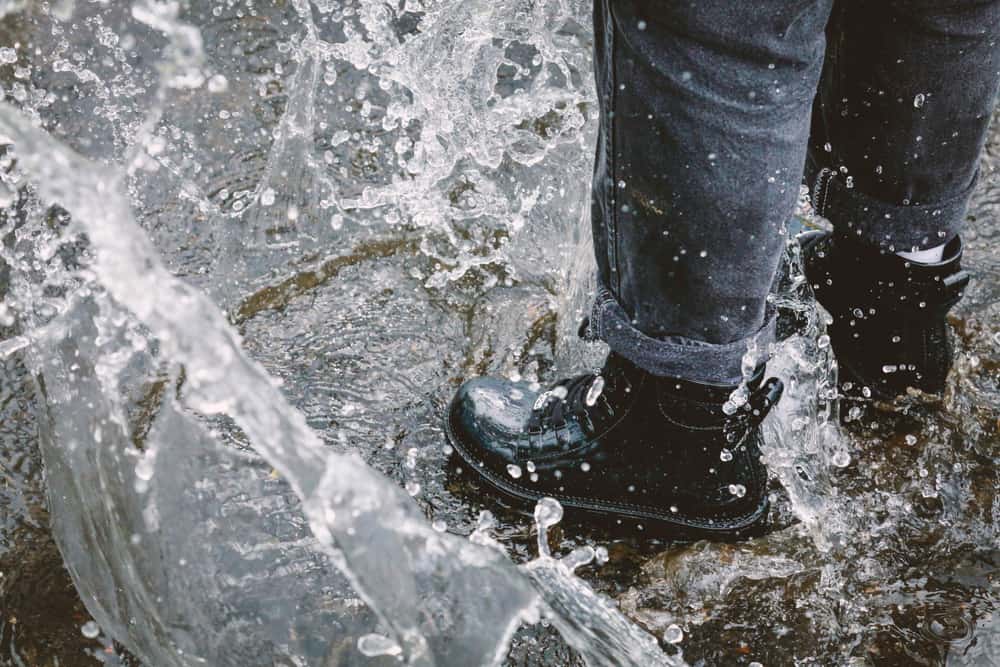
What the words on the bottle mean
Three terms get used almost interchangeably in this aisle and they are not the same thing. Knowing which one you are buying removes most of the disappointment.
- Water-repellent (or DWR). A finish on the surface of the material that makes water bead and roll off. It wears off with abrasion and washing, and it is what every spray on this site actually is. Nothing on a shelf reapplies itself.
- Waterproof. A property of the boot’s construction - a membrane, a thick wax film, or molded rubber. A spray cannot add this to a boot that was not built with it.
- Breathable. Vapor from your foot can leave through the material. This is the property a wax destroys and a water-based spray preserves, and it is the entire reason the two formats exist side by side.
Read those together and the usual complaint - “I sprayed them and they still got wet inside” - often turns out to be sweat rather than rain, on a boot that was sealed rather than proofed.
Why it wears off exactly where it does
A repellent finish is a coating on fibers. Anything that abrades the fibers or flexes them repeatedly removes it faster, which is why the wear pattern is so predictable.
The flex crease across the vamp goes first, because it opens and closes thousands of times a day. The welt and the rand seam go next, because they sit in standing water and collect grit that works like fine sandpaper. The toe cap, which is what everybody tests, is nearly the last place to fail - which is why testing the toe tells you almost nothing useful.
Washing removes it too, which catches people out. A trip through a washing machine strips a DWR finish comprehensively, and that is one of several reasons not to put boots in one.
The four reasons it fails
When somebody tells us a spray did nothing, it is almost always one of these, and all four are addressed in the makers’ own directions.
- It went on a dirty boot. Both Nikwax and Grangers specify clean footwear. A proofer applied over trail dust and body oils bonds to the dirt rather than the fibers, and leaves with it. This is the single most common failure and it is why the cleaning gel is on this page.
- It went on a bone-dry boot. Water-based proofers are meant to be applied damp - Nikwax says “clean, wet”, Grangers says “freshly-cleaned, damp”. On a dry surface the treatment sits on the outside and dries in patches instead of distributing along the fibers.
- The excess was left to dry in place. Nikwax gives a two-minute window before wiping the surplus off. Surplus that dries on the surface looks like a stain and does nothing useful.
- The wrong product for the material. A nubuck proofer on smooth leather, or a leather product on a mesh panel, treats part of the boot and leaves the rest bare. Water comes in through the bare part and the whole treatment gets blamed.
Two problems no spray can fix
A cracked or split upper. Once leather has cracked through at the flex crease, that is a hole, and a repellent finish does not bridge holes. No product closes that crack - which is why the conditioning routine that prevents it matters more than any proofer. That is covered in dry and cracking leather boots.
A failed seam or a damaged membrane. If water is arriving through the stitching or through a delaminated liner, the outer surface is not the problem and treating it will not help. The tell is water appearing in one specific spot rather than the boot gradually wetting through all over.
Before concluding either, though, clean the boots properly and re-proof once. A membrane boot that has “failed” is very often just an outer face fabric so clogged that it wets out - and cleaning it brings the boot back.
The test that answers this for your boots
Drop a little water on the flex crease across the vamp and on the welt seam, and watch for thirty seconds. Beads that sit up and roll off mean the finish is working. Water that darkens the material and soaks in means it has worn through there.
Test those two places rather than the toe cap. They abrade the most, they fail first, and the toe will still be beading long after the crease has given up. The full method is in how often should you reproof boots.
How long it lasts, honestly
Nobody knows, because nobody publishes it. We have read the product pages for every proofer on this site and not one manufacturer states a reapplication interval. Any specific figure you have seen - every six weeks, every twenty wears - came from a publisher rather than a maker.
What we can say from the mechanism is directional and honest: a surface treatment on a material that flexes and abrades will wear through fastest where the flexing and abrasion happen. That is the crease and the welt, and that is where to test. A boot worn daily on wet ground will need it more often than a boot worn at weekends.
How to test it properly
- 01
Start with clean boots
Testing a dirty boot tests the dirt. Wipe the area you are about to test and let it dry - a surface crusted with trail dust will wet out whatever is underneath it.
- 02
Drop water on the flex crease, not the toe
A few drops on the fold across the vamp, and a few on the welt seam. Those are the two places that fail first. The toe cap will still bead long after the rest of the boot has given up.
- 03
Watch for thirty seconds
Beads that sit up with a high contact angle and roll off when you tilt the boot mean the finish is intact. Water that flattens out and darkens the material has wetted out - the finish there is gone.
- 04
Check both boots
People walk asymmetrically and one boot frequently fails before the other. If one is beading and one is not, that is normal and it tells you the test is working.
Do that test every few weeks in the wet season rather than waiting for wet socks. It takes thirty seconds and it is the only reliable answer, because no manufacturer publishes an interval you could use instead.
When a spray is the wrong purchase entirely
If your boots are smooth full-grain leather with no membrane and they live in mud, a wax will out-last any spray by a wide margin - it builds a film rather than coating fibers, and that film survives abrasion a repellent finish does not. Atsko publishes a full method for it, including a hard ceiling of a comfortable handling temperature of 120 F when preheating.
The cost is breathability and color: wax seals, and Atsko says plainly that it darkens leather. On a membrane-lined boot that seal is a mistake, which is the whole argument in wax vs spray vs cream.
What about the aerosols, and the ones that claim a permanent bond?
Two marketing categories worth a sentence each, because both come up whenever this question is asked.
Aerosols are a delivery format, not a different chemistry. They reach seams and lace channels better than a pump spray and they waste more product on the air and the sole. Whether a given aerosol is any good depends on what is in the can, and most of them publish considerably less about that than the pump-spray brands do.
Anything sold as permanent deserves suspicion. A repellent finish sits on a material that abrades and flexes every time you walk, and nothing survives that indefinitely. No manufacturer on this site claims permanence, and the ones with the most detailed published directions are conspicuously the ones making the most modest claims.
One thing a spray genuinely does beyond water
Stain resistance, which gets less attention than it deserves. A treated upper sheds mud, coffee and road spray the same way it sheds rain, which means dirt sits on the surface and brushes off instead of working into the grain. On suede and nubuck that is arguably worth more than the waterproofing.
The honest cost of keeping boots repellent
A bottle of proofer treats several pairs and lasts a season or two for most people, and the cleaning product that has to go with it lasts about as long. Set against that, re-proofing is one of the cheapest maintenance habits in boot care - the real cost is the fifteen minutes and remembering to do it before the wet season rather than during it.
That timing is the part worth acting on. A boot treated in September behaves differently all winter from the same boot treated in January after two months of wetting out, because every soaking in between was also stripping oils out of the leather. Proof early and the rest of the season is easier.
So is it worth buying?
For a membrane-lined boot, yes, and it is close to mandatory - the membrane cannot do its job through a soaked outer. For a fabric or nubuck boot, yes. For smooth leather in genuinely wet work, a wax is the better buy. For a boot that is already cracked through, no product on this site will help and you are looking at a repair or a replacement.
Which one to buy for your material is ranked in the waterproofing spray roundup, and the hiking-specific case is in the best waterproofing for hiking boots.
What we would buy for this
Chosen from the same registry as our roundups, on published specifications rather than on testing we have not done.
Nikwax
Nikwax Fabric & Leather Proof
The mixed-material answer: one water-based treatment for boots that are part leather and part textile, which is most modern hiking boots.
Skip it if: You want a wax finish that visibly darkens and armors the leather - that is Sno-Seal's job, not this.
#ad Price as of September 13, 2026, from Amazon. Prices change. How this site is funded.
Grangers
Grangers Footwear Repel Plus
The largest bottle here with published damp-application directions - 275 ml against Nikwax's 125, for the same wet-boot workflow.
Skip it if: You only own one pair - you will not finish the bottle before it separates.
#ad Price as of September 13, 2026, from Amazon. Prices change. How this site is funded.
Nikwax
Nikwax Footwear Cleaning Gel
The cleaning half of the two-step Nikwax system, and the one people skip - which is why their proofer never lasts.
Skip it if: Your boots are plain smooth leather with a wax finish - saddle soap is cheaper and does the same job.
#ad Price as of September 13, 2026, from Amazon. Prices change. How this site is funded.
Atsko
Atsko Sno-Seal Original Beeswax
A beeswax dressing with the most specific instructions in the category - including a hard 120 F ceiling on preheating that almost nobody reads.
Skip it if: Your boots are suede. Atsko says outright it is not recommended for suede, and will darken and flatten the nap.
#ad Price as of September 13, 2026, from Amazon. Prices change. How this site is funded.
Frequently asked
Does waterproofing spray actually work on boots?
Yes, by a published mechanism: the treatment coats the individual fibers with water-repellent molecules and leaves the spaces between them open, so water beads off while vapor still escapes. What it produces is water repellency rather than waterproofness - a long enough soaking will still get through.
Why did my waterproofing spray not work?
Usually one of four things: the boots were dirty, the boots were bone dry when water-based proofers want them damp, the excess was left to dry on the surface, or the product was formulated for a different material than the boot is made of. All four are addressed in the makers’ own directions.
Is waterproof spray or wax better for boots?
It depends on the boot. Wax builds a durable sealed film and wins on smooth full-grain leather with no membrane. Spray coats the fibers and leaves them breathable, which is the only correct choice on a membrane-lined or part-textile boot, because wax would seal the membrane shut.
How do I know if my boots need re-waterproofing?
Drop water on the flex crease across the vamp and on the welt seam. If it beads and rolls off, the finish is intact. If it darkens the material and soaks in, it has worn through. Test those spots rather than the toe, which stays beading long after the crease has failed.
Can waterproofing spray fix leaking boots?
It can fix a boot that is wetting out through a dirty or worn outer - clean and re-proof and it often comes back. It cannot fix a cracked upper, a failed seam or a damaged membrane. Water arriving at one specific spot rather than gradually all over points at damage rather than a worn finish.
Where the figures on this page came from
- Nikwax - How Nikwax works (water-based chemistry, breathability, no heat required)
- Nikwax - Nubuck & Suede Proof directions (wet application, 15 cm, 2-minute dwell)
- Grangers - Footwear Repel Plus (275 ml, damp application, PFC-free)
- Atsko - Sno-Seal application tips and instructions (120 F ceiling, method)
- Nikwax - Footwear Cleaning Gel directions and chemistry