Every spray here is judged on what its maker publishes: which materials it is cleared for, whether it goes on wet or dry, and how much bottle you get. Not on a soak test we did not run.
By Scooter M., Enthusiast. Published September 1, 2026.
We earn a commission if you buy through the links on this page, at no extra cost to you. It never changes a ranking, and we recommend products with no affiliate link behind them where those are the right answer. Full disclosure.
Quick picks
The shortlist, ranked
Ranked on published manufacturer specifications and, where a wattage figure exists, computed running cost. Tap any row for the full write-up, including who should skip it.
#
Product
Best for
Score
Price
01
Nikwax Nubuck & Suede ProofSuede and nubuck, including membrane-lined boots
Scores are ours and editorial. They are never published as review or rating markup, because we have not tested these products.
Buy the spray that matches your boot material, then buy the one you will actually use. Those are different questions and the second one decides more outcomes. A proofer that has to go on clean, bone-dry boots gets used twice a year. A proofer whose own directions say to spray it on wet boots gets used the moment they come off your feet, which is the only time you are ever standing next to them holding a bottle.
What we did instead of testing
We have not soak-tested these. There is no lab here and no tank of water, and claiming otherwise would be the easiest thing on this page to disprove. What we did was read every manufacturer’s published directions and record four things that actually separate these products: which materials the maker clears the product for, whether it is applied wet or dry, how long you have to leave it before wiping, and how much you get in the bottle.
That comparison turns out to be unusually decisive here, because the makers genuinely disagree with each other about the basics. Nikwax tells you to apply to wet footwear, while Atsko tells you to preheat clean, dry boots. Both are right for their own chemistry, and picking the wrong one for your routine is why a bottle sits unopened.
Spray proofers are the low-effort end of the category. The good ones tell you exactly how far to hold the can and how long to wait.
Wet or dry: the only spec that changes your habits
Water-based proofers are designed to be carried into the leather or fabric by the water already in it. That is why Nikwax specifies wet application and Grangers specifies damp. Solvent and wax treatments need the opposite, because water in the leather blocks the wax from getting in.
Product
Applied to
Published size
Cleared for
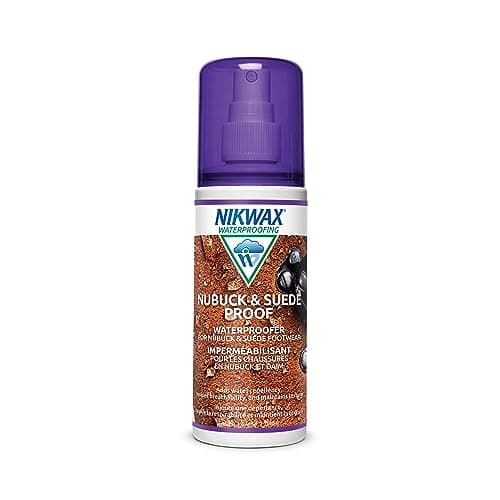
Nikwax Nubuck & Suede Proof
Clean, wet footwear
125 ml
Nubuck, suede, incl. Gore-Tex / eVent / Sympatex
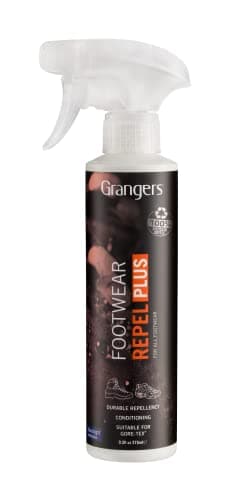
Grangers Footwear Repel Plus
Freshly cleaned, damp footwear
275 ml
Gore-Tex, eVent, suede, nubuck, leather, fabric
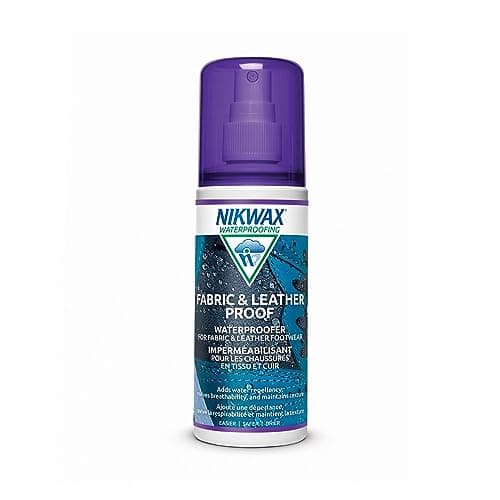
Nikwax Fabric & Leather Proof
Clean footwear, no heat needed
Not published in a single figure
Mixed leather-and-textile footwear
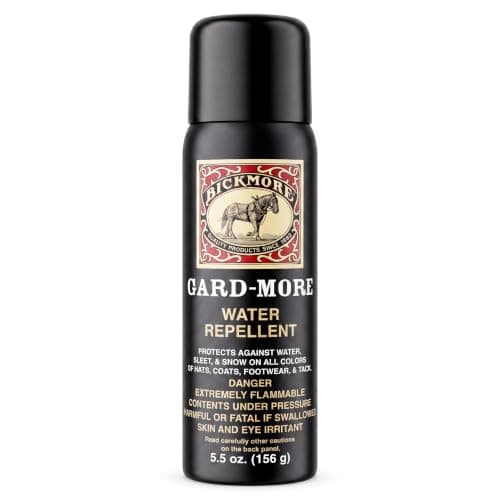
Bickmore Gard-More
Clean, dry footwear
Not published
Marketed as a general water and stain repellent
Note the last row. Bickmore publishes very little in the way of specifications for Gard-More, and we have scored it accordingly rather than filling the gap with an estimate. It is here because a single can that covers a mixed rack is a real use case, not because we can tell you more about it than its maker does.
The breathability question
If your boots have a membrane - Gore-Tex, eVent, Sympatex - the proofer has to repel water from the outside without sealing the fabric from the inside. Nikwax publishes the mechanism: elastic water-repellent molecules coat the fibers individually and leave the spaces between them open, so vapor still escapes. A wax, by design, fills those spaces. That is the whole reason you do not put Sno-Seal on a membrane boot, and it is not a brand argument - it is what each product is for.
The PFAS point, stated carefully
Nikwax states its products are water-based and PFAS-free, and that it has never used fluorochemicals. Grangers states Footwear Repel Plus is PFC-free. We are reporting what each maker publishes about its own product, not making a safety claim about the category or about anyone else’s.
What we would actually buy
One pair of suede or nubuck boots: the 125 ml Nikwax. A household with several pairs going out in the wet: the 275 ml Grangers, because the per-application cost is what matters once you are treating four pairs in October. Smooth full-grain leather work boots: none of these - go to the wax roundup instead, because wax is the right tool for that material.
One construction needs picking out of this list separately. A hiking boot is usually part leather, part textile and membrane-lined, which rules out wax entirely and narrows the shortlist to the treatments cleared for membranes - the best waterproofing for hiking boots covers that case. And if you are not convinced any of this does anything, does waterproofing spray actually work answers it with the published mechanism.
The write-ups
Every pick, in full
01 / Best overall
Nikwax
9.0 / 10
Nikwax Nubuck & Suede Proof
The only mainstream footwear proofer whose directions tell you to apply it to WET boots, which removes the step everybody skips.
−Sprays generally need more frequent renewal than a wax
Skip this one if
You want published composition or a dwell time - Bickmore does not publish a spec sheet for it.
How it scores, by criterion
Documented use5.0
Material range9.0
Reapplication burden7.0
Published composition4.0
Coverage per can8.0
How these picks were chosen
Everyone in this category says they tested twenty dryers. We have not tested any, and we say so. What we did instead: read the manuals, compile the published specifications, compute the running cost from the manufacturer's own wattage figure, and show the arithmetic so you can check it.
It depends entirely on the chemistry, and the maker tells you. Nikwax publishes directions to apply to clean, wet footwear. Grangers says freshly cleaned and damp. Atsko says preheat clean, dry boots before applying Sno-Seal. Water-based proofers ride in on the moisture; waxes are blocked by it.
Do waterproofing sprays stop boots breathing?
The water-based ones are designed not to. Nikwax publishes the mechanism - the repellent coats individual fibers and leaves the gaps between them open, so vapor still passes. Waxes work by filling those gaps, which is why they are the wrong choice for a membrane-lined boot and the right one for a solid leather work boot.
How far away should you hold the spray?
Nikwax publishes 6 inches, or 15 cm, for Nubuck & Suede Proof, then says to remove the excess after 2 minutes and let the boots dry naturally. That two-minute dwell is the step people skip, and it is the difference between a coating and a stain.
Can I use one spray on every pair I own?
Mostly, if you pick a broad-spectrum one. Grangers lists Gore-Tex, eVent, suede, nubuck, leather and fabric on the same bottle. The exception is smooth full-grain leather that you want visibly armored rather than just repellent - that wants a wax, and a wax will darken and flatten suede, so it is not a one-can-covers-all situation in the other direction.
Where do the prices on this page come from?
From a live Amazon lookup, refreshed daily and shown with the date it was taken. We only print a figure we hold from the last 48 hours; past that it disappears on its own and the button reverts to “Check price on Amazon”. A remembered price on a product that has been repriced twice since is worse than no price.