Three rubber boot makers publish the same instruction - dry them naturally, away from artificial heat. That is a stricter rule than leather gets, and it decides this entire shortlist.
By Scooter M., Enthusiast. Published September 8, 2026.
We earn a commission if you buy through the links on this page, at no extra cost to you. It never changes a ranking, and we recommend products with no affiliate link behind them where those are the right answer. Full disclosure.
Quick picks
The shortlist, ranked
Ranked on published manufacturer specifications and, where a wattage figure exists, computed running cost. Tap any row for the full write-up, including who should skip it.
Scores are ours and editorial. They are never published as review or rating markup, because we have not tested these products.
Start with the rule the boot makers publish themselves, because it eliminates half this category before you compare anything. The Original Muck Boot Company says to let your boots dry naturally, away from artificial heat sources, and gives the reason plainly: “Heat can potentially create cracks and crazing that will compromise your Muck Boots’ waterproof protection.”
Three manufacturers, three continents of customers, one instruction. So the shortlist below is built around gentle, unheated air and vertical reach - not around the one-to-two-hour claims that sell dryers everywhere else on this site.
Why a rubber boot is the hardest thing here to dry
Leather is a membrane. Water leaves a leather boot through the whole upper as well as out of the opening, which is why a leather boot left in moving air makes steady progress overnight.
Rubber does not do that at all. A rubber boot is a sealed shell, so every gram of water inside it has exactly one exit: the top. That single fact produces the three problems this page is about.
The wettest part is furthest from the exit. On a knee boot the footbed is eighteen inches down a sealed tube, in air that is not moving. Whatever you use has to reach down there, not blow across the opening.
The lining is a sponge. Muck describes its uppers as natural rubber and neoprene. Neoprene is closed-cell foam wrapped in fabric, and it holds water far longer than a leather lining does.
You cannot cheat with heat. On leather, heat is a bad idea that hardens the fibers. On rubber it is worse: all three makers above tie heat directly to crazing and cracking, and a cracked rubber boot is not a cosmetic problem. It is a boot that leaks.
Where most of these boots actually live. Twelve hours on, hosed off, and back on at dawn - which leaves one overnight window to move a lot of water.
What we ranked on
Four questions, in this order. We have not tested any of these; every figure below is the manufacturer’s own, and the method is in how we research.
Published reach. The one specification that can make a dryer useless rather than slow. A 22-inch stand does nothing for the footbed of a knee boot.
Heat: none, or a published ceiling. Given what Muck, Xtratuf and Hunter publish, an unheated convection dryer is the default and anything with a heat element needs a temperature figure in writing before we will list it.
Airflow into a sealed volume. Rubber gives you no help. The dryer has to deliver air to the bottom of the shaft and give the moist air somewhere to go.
Published wattage, and therefore running cost. These boots get worn daily by the people who own them, so this runs every night for a season, not occasionally.
The five, on published figures
Option
Reach
Heat
Power
Warranty
PEET Wader
42.5 in
None - convection
36 W
25 years
PEET Original XL Tall
24.5 in
None - convection
36 W
25 years
PEET Multi
25 in, 4 ports
None - convection
72 W
25 years
DryGuy Force Dry DX
4 garments, extension tubes
Capped at 105 F
Not published
1 year
Boot shapers
Full shaft
None
None
n/a
Why the Wader wins, and it is not close
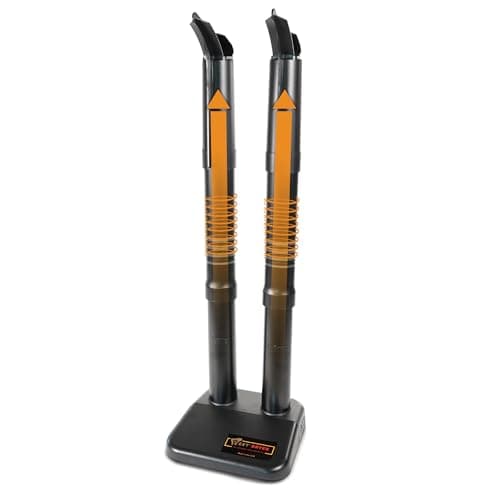
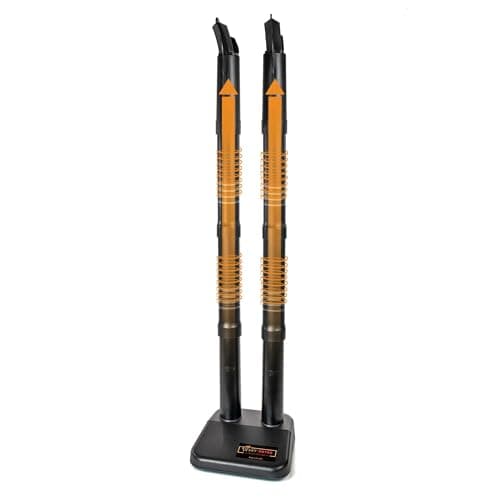
At a published 42.5 inches it is the only dryer we can source a figure for that reaches the top of a hip wader or the footbed of a knee boot from the inside. On this page that is not a nice-to-have; it is the entire job.
It is also convection. No fan, no element you can set too high, nothing to get wrong - which lines up exactly with what Muck, Xtratuf and Hunter tell you to do. At 36 watts it draws 0.3 amps and costs about five cents for an eight-hour night. PEET warrants it for twenty-five years, with registration inside ten days.
Its honest cons are on the card and they are real. It needs three and a half feet of vertical clearance, which is a genuine constraint in a low mudroom or under a shelf. It does one pair at a time. And it is an overnight dryer - PEET’s own FAQ puts its non-fan models at four to eight hours, or overnight. For a sealed knee boot, expect the upper end of that.
If your rubber boots are ankle or mid height
Plenty of muck and garden boots stop below the calf, and for those the Wader is three feet of tube you are not using. The XL Tall runs the same 36-watt element and the same twenty-five-year warranty at a published 24.5 inches, which reaches the footbed of anything short of a knee boot.
Worth being explicit, because it is the most common misunderstanding about this range: the taller model does not dry faster. Same element, same wattage, same published drying window. You are buying reach and nothing else. Every model in the range is laid out side by side in which PEET dryer should you buy.
Farms and families: the four-port case
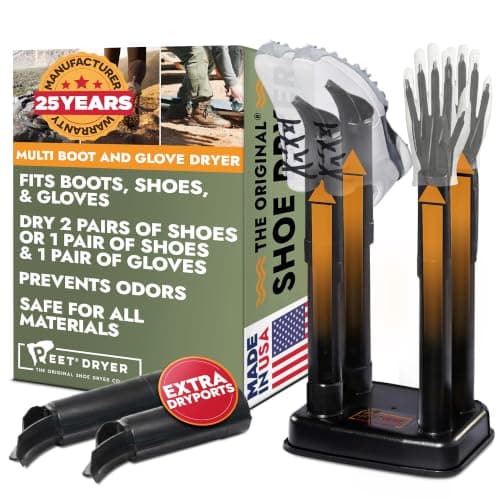
Rubber boots rarely arrive one pair at a time. The Multi runs four ports on 72 watts - two pairs, or a pair plus gloves - and stays silent and unheated, which keeps it inside the manufacturers’ instruction.
Two honest limits. At 25 inches it will not reach into a knee boot, so it is the wrong buy if your boots are wader height. And doubling the ports doubled the wattage: two pairs on a Multi cost the same to run as two Originals. What you save is an outlet and a footprint, not electricity.
Unheated, 36 watts, and tall enough to reach the footbed. On rubber that combination matters more than speed.
The forced-air option, and the caveat it comes with
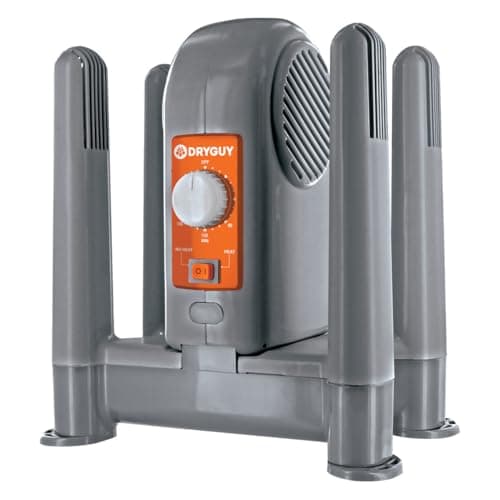
Sometimes the boots have to be dry before the next shift and overnight is not available. The Force Dry DX is the honest answer to that, and it is fourth here rather than absent because DryGuy publishes something most of this category does not: a maximum temperature of 105 F, a three-hour timer and a one-to-two-hour drying time, with extension tubes for taller boots.
That published ceiling is the only reason it qualifies. A hundred and five degrees is barely above a warm room, and it is a manufacturer accepting a limit in writing rather than leaving you to guess. Set against a heat gun, a radiator or a wood stove - all of which have no ceiling at all - it is by far the safer way to hurry a rubber boot.
We would still use it as the exception rather than the routine. Muck’s instruction is to dry naturally away from artificial heat sources, full stop, and a dryer that runs an element is artificial heat even at 105 F. Our reading: run it when the schedule forces it, run the unheated stand the rest of the time. And note the other cost - DryGuy publishes no wattage for it, so nobody can tell you what it costs to run. The wider brand comparison is in PEET vs DryGuy.
What the makers ban outright
Muck: dry naturally, away from artificial heat sources - heat can create cracks and crazing that compromise the waterproof protection. Xtratuf: dry naturally at room temperature; sunlight, artificial heat or sub-zero storage makes natural rubber brittle. Hunter: avoid extreme temperatures or direct sunshine, which can cause the boot to crack or break.
In practice that rules out the radiator, the wood stove, the hair dryer, the car heater vent, the airing cupboard and - the one people are surprised by - leaving them out in the sun to dry. Sunshine is a heat source and a UV source at the same time, and it is the worst place you can put a rubber boot.
Storage is part of drying, on these boots more than any other
Muck is specific: store them upright to avoid creasing or folding, and avoid direct sunlight, artificial heat or sub-zero temperatures, “as this can cause the rubber to become brittle, deteriorate and crack”.
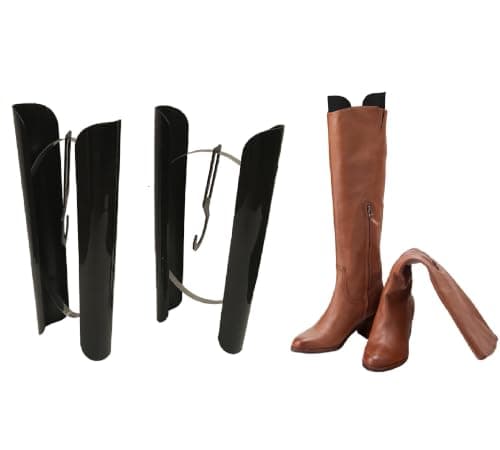
A knee-height rubber boot left on its side folds at the ankle, and unlike leather that fold does not relax out - it becomes a permanent hinge, and a hinge in a waterproof shell is where the first split appears. Boot shapers are on this list for that reason. They cost very little, they fold flat out of season, and they are the difference between a boot that lasts five winters and one that splits in its second.
Their honest limit is that they do nothing about moisture unless you buy a cedar version. Dry the boot first on one of the four options above, then shape it for storage. In that order.
The other half of rubber boot care, which this page does not rank
Drying is one failure mode. The other is the rubber itself going brittle from UV and age, and it is worth knowing that a different product class exists for it - we are not ranking those here because this is a dryer roundup, but you should not finish this page thinking a dryer is the whole job.
Xtratuf tells you to nourish the boots with wax polish or Grangers Rubber Boot Care, a 150 ml spray whose maker describes it as removing blooming, conditioning and restoring shine on all rubber footwear, applied from 10 to 15 cm and rubbed in immediately with a dry cloth. Muck names wax polish, Armor All or liquid detergent for the same purpose - keeping the rubber supple, boosting UV protection and avoiding cracking or splitting over time.
For UV specifically, 303 Aerospace Protectant is the best-documented option we could source: Gold Eagle publishes that it blocks up to 98% of UV radiation if used properly and consistently, lists synthetic and natural rubber among its surfaces, is water-based and silicone-free, and recommends reapplying every 30 to 45 days on constantly-exposed surfaces.
On blooming - the white powdery film that turns up on good rubber boots - Hunter is reassuring and worth quoting, because most owners assume it is mold: it is simply that “natural rubber is a premium material that sometimes shows a white, powdery film called blooming”. It wipes off. If what you are looking at is fuzzy rather than powdery, that is a different problem and it is covered in the mold and mildew guide.
What not to put on a rubber boot
Most of the product advice on this site is for leather, and almost none of it transfers. Rubber is not porous, it has no oils to replace, and it does not absorb anything you rub into it.
Leather conditioner. Nothing to condition. It sits on the surface collecting grit.
Mink oil or any oil paste. No benefit, and oils are not friendly to rubber compounds over time.
Saddle soap. Made for leather. Cold water and a soft brush is what all three makers publish for cleaning rubber.
Beeswax proofers such as Sno-Seal. The boot is already waterproof. Atsko’s method involves preheating the boot, which is the one thing you must not do here.
If you own leather boots as well, none of that means those products are bad - they are simply for the other pair. The leather routine is in how often to condition boots.
Hose the mud off with cold water before it dries. Everything else on this page assumes you started with a clean boot.
The smell, which is worse on these than on anything else
A sealed, unlined-or-neoprene boot with no breathability is the most favorable environment for odor that exists in footwear, and rubber boot owners know it. The mechanism and the one variable you actually control are in why wet boots start to smell.
The practical short version for these boots specifically: get them properly dry between wears - which is what everything above is for - and put something adsorbent down the shaft afterwards rather than a fragrance. Options are ranked in the charcoal deodorizer roundup.
Wader and XL Tall, 36 W: 0.288 kWh a night, 5.3 cents, $4.75 a season.
Multi, 72 W: 0.576 kWh a night, 10.6 cents, $9.51 a season - $4.75 per pair.
Force Dry DX: no published wattage, so no honest figure exists.
Under five dollars for a whole wet season is the real headline, and it is the reason the running cost should not decide this purchase. Decide on reach first, then heat, then ports. Check the figure for your own electricity rate in the running-cost calculator if the national average is not close to what you pay.
The write-ups
Every pick, in full
01 / Best for knee boots and waders
PEET
8.7 / 10
PEET Wader Dryer
42.5 inches of tube on the same 36-watt element - the only dryer here that reaches the top of a hip wader or a knee boot.
+Temperature capped at 105 F, gentler than an unregulated heat source
+Four garments at once, with extension tubes for taller boots
What it does not
−No published wattage, so its running cost cannot be computed from the maker's own data
−1-year warranty against PEET's 25
−Fan noise
Skip this one if
You want to know what it costs to run. The maker publishes temperature, timer and dimensions but not watts or amps, and we will not print a number we cannot source.
+Prevents the permanent ankle crease that ruins tall boots
+Cheap
+Folds flat out of season
What it does not
−No moisture absorption unless you buy a cedar version
−Only useful for tall shafts
−Flimsy at the bottom of the price range
Skip this one if
Your boots are ankle height - a cedar tree is the better answer.
How it scores, by criterion
Documented use7.0
Moisture handling4.0
Shape retention9.5
Published composition5.0
Value per pair8.5
How these picks were chosen
Everyone in this category says they tested twenty dryers. We have not tested any, and we say so. What we did instead: read the manuals, compile the published specifications, compute the running cost from the manufacturer's own wattage figure, and show the arithmetic so you can check it.
Yes, provided it is not a heat source. Muck, Xtratuf and Hunter all publish that rubber boots should dry naturally away from artificial heat, because heat makes rubber brittle and causes crazing that compromises the waterproofing. An unheated convection dryer such as the PEET Wader is the safest option, and it reaches a published 42.5 inches.
How do you dry rubber boots quickly?
There is no genuinely fast option that the boot makers endorse. The quickest defensible route is a forced-air dryer with a published temperature cap - the DryGuy Force Dry DX publishes 105 F and a one-to-two-hour time - used as an exception rather than nightly. Never a radiator, hair dryer, wood stove or direct sun.
Why did my rubber boots crack?
Heat, sunlight or freezing storage, in most cases. Xtratuf publishes that direct sun, artificial heat or sub-zero temperatures make natural rubber brittle and cause it to deteriorate and crack, and Muck says heat can create cracks and crazing that compromise the waterproof protection. Storing them folded rather than upright creates the same failure at the ankle.
What is the white film on my rubber boots?
Almost always blooming, not mold. Hunter describes it as a white, powdery film that natural rubber sometimes shows, and it wipes off. Grangers Rubber Boot Care is sold specifically to remove it. If the deposit is fuzzy rather than powdery and smells musty, treat it as mold instead.
What dryer reaches the bottom of knee-high rubber boots?
The PEET Wader, at a published 42.5 inches, is the only model in this comparison with enough reach for knee boots and hip waders. It runs the same 36 watts as the short models, so the extra height costs nothing to power.
Should you condition rubber boots?
Not with leather conditioner - rubber has no oils to replace and absorbs nothing. What the makers do recommend is a rubber-specific treatment for UV and appearance: Xtratuf names wax polish or Grangers Rubber Boot Care, and Muck names wax polish, Armor All or liquid detergent, to keep the rubber supple and reduce cracking.
How should you store rubber boots?
Upright, dry, and out of the sun. Muck publishes storing them upright to avoid creasing or folding, and away from direct sunlight, artificial heat and sub-zero temperatures. Boot shapers hold a tall shaft upright and stop the permanent ankle crease that eventually splits.